In this post I would like to tackle the topic that every gamer finds relevant at some point: how games affect his or her life? Usually this question comes with something along the lines of: “You spend to much time on the games”, “it’s just for children”, “how can games help you in your future career” and so on. Well, I for once decided to open a blog about them, that’s how they influence my career, but I digress.
I want to describe some positive effects that playing video games can have on a person in different stages of their life.
However, the very first thing I must mention is game addiction. It’s not a positive effect but a negative one and the effects that I talk about are not excuses for game addicts to stay at home playing games instead of touching some grass outside.
Gaming as hobby and addiction

In order for you to understand better where is the border between healthy amount of entertainment and an addiction, I shall say that after reading some posts and articles on the topic, I’d say up to an hour a day is mostly safe but spending more time in games daily may be a little red flag about dependence on games being necessary part of the routine.
Surely, the situations are different and children, for instance, may have got more time on their hands than an average adult, yet I wouldn’t switch the norms for them too much. The thing about addiction is that it takes time from your life that should be spent on other matters but is wasted on something that is not essential. So if you or your child goes to school and later spend a couple of hours in games while having good grades and other hobbies, then, I personally don’t see anything to worry about just yet.
Genres and Ages
To begin with, the studies I’ve read talked about how different ages can use different games to help them but it doesn’t mean that the games are age-restricted on the effects, they are only age-restricted by the type of content inside them.
Children and Casual Games
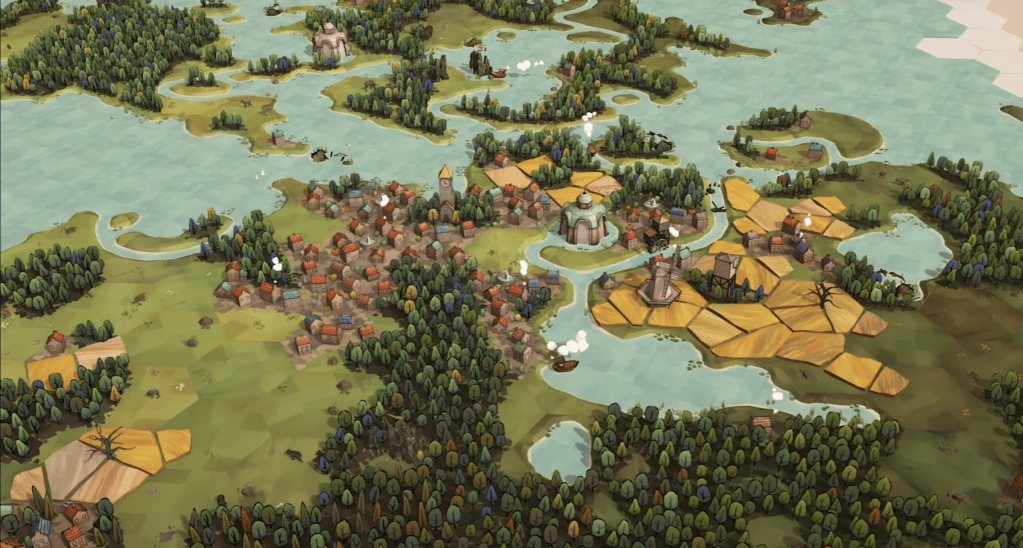
This is a widely discussed topic since the main alternative to games for stress reduction is meditation. It’s obvious that games are more appealing to the majority of the children in comparison to controlling your breath and thought while staying perfectly still for some time. The researchers have found out that playing just about half an hour a day may help children release stress.
The games in question are casual games. Think of Animal Crossing, Stardew Valley, Dorfromantik, Islanders, and the majority of smartphone time-killer games. Let’s not consider Flappy Bird here, although, I found it rather relaxing when I played it. One may also think, Infinity Nikki if you want something more complex, but after my first experience with its controls (especially after Genshin), I’d say it will take some time for it to become a relaxing game. Nevertheless, I nice choice as well.
Needless to say, that the study was about stress reduction and the children were the test subjects, so I stoke of them. It doesn’t mean that the same positive effect cannot be experienced by an older person who wants to calm down and blow off some steam.
Adults and Action Games

Another interesting topic would be an extensive study on action games and whether they can be beneficial. Again, just like with children, moderate amount of gaming can increase mental abilities. This happens due to the mechanics used in fast-paced action games.
Since the player is expected to swiftly read the environment and strategize quickly, the positive effects of playing action games include “perception, top-down
attention, spatial cognition, inhibition, task-switching/multi-tasking, problem solving and
verbal cognition” (Benoit Bediou et al., 2017, p. 42).
If we want to consider age restrictions for this category of games, I have to say that a large amount of action games also contains violent content not suitable for younger audience. Games like Call of Duty, Doom, and Counter Strike should not be suitable for children. On the other hand, Splatoon qualifies as an action game by the study but is noted to not have any violance, which makes it a good candidate for children. As for older audience, depending on their abilities they may find it difficult to keep up to the pace, but it’s not always the case.
Elderly People and Strategy Games

The final category i want to mention is game therapy for elder people. When I say elder, I mean 60 and up since this is how it was described in the articles.
It’s been discovered that strategy games can improve cognitive control and reasoning as well as stave off dementia and Alzheimer to some extend.
The researchers have also noted that 3-D game environments are nor beneficial than the 2-D ones due to the fact that tree dimensions activate more areas in the brain. By no means I wish to say that 3-D games are better than the 2-D ones. Most of the time it’s a stylistic choice or correct resource management.
Either way, these are some interesting facts about how video games can influence us. Below, I would like to provide the articles that i have used to write this post. I’ve seen a few other articles, but these are the ones that were most influential. After all, it’s not a scientific paper, so I’ll allow an academic in me screech over an incomplete bibliography list without a proper format.
References
“Meta-Analysis of Action Video Game Impact on Perceptual, Attentional, and Cognitive Skills” by Benoit Bediou et al., 2017 (https://psycnet.apa.org/manuscript/2017-52625-001.pdf)
“How video games affect the brain” by Hannah Nichols, 2023 (https://www.medicalnewstoday.com/articles/318345)
“Stress-Reducing Effects of Playing a Casual Video Game among Undergraduate Students” by Veeral Desai et al., 2021 (https://pmc.ncbi.nlm.nih.gov/articles/PMC7952082/pdf/43076_2021_Article_62.pdf)
 Geeky Nerd
Leave a comment