This is the continuation of the previous post on colour theory. It will tacle the black and white colours and also some common colour markers that are used in games. It’s important to keep them in mind when developing your first game because these markers compose the “colour code” of games and breaking away from it without a perfectly good reason can only confuse players.
Light, Sky and Whatnot
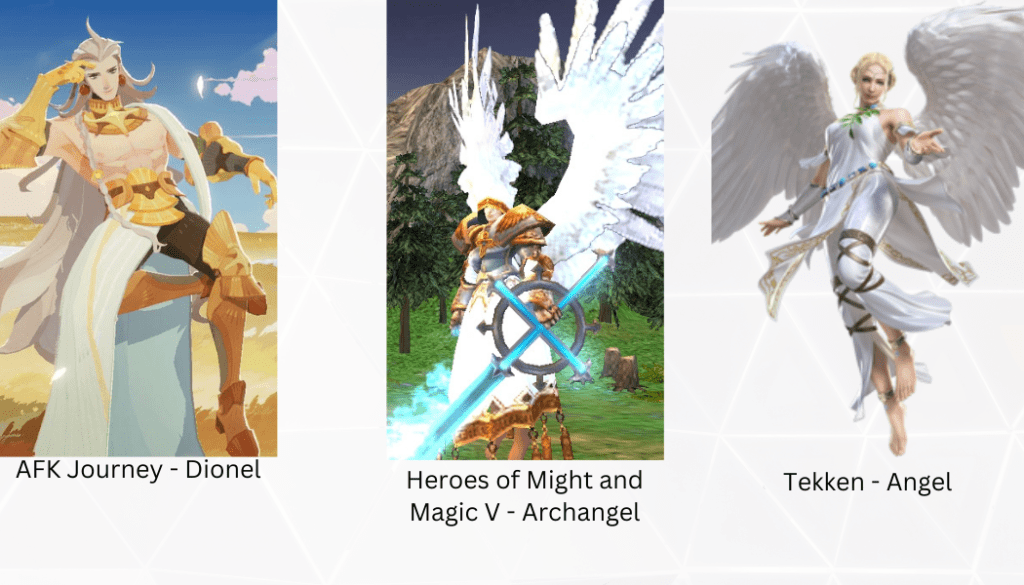
In this part I will talk about white and gold colours since they are very common in depicting heavenly forces and generally pure good creatures.
Both colours are deeply rooted in culture but mostly Western. Red may also serve to depict positive powers. For example, in Japan, in the kabuki theatre heroes wear masks with red markings and blue marking are designated to evil characters.
Dark, Abyss and Whatnot
This part is about the black and purple since they are the most common to convey evil in many video games. Instead of purple, red or green may act as a complimentary colour but they are less common.
Here, I can say that the complimentary colour is most commonly associated with the origin of evil. Purple goes for some abyssal powers of unknown pure evil power. Red mostly goes for the bloodthirsty power and traditionally Christian depiction of demons. Necromancy and the undead are associated with green.

Common Markers
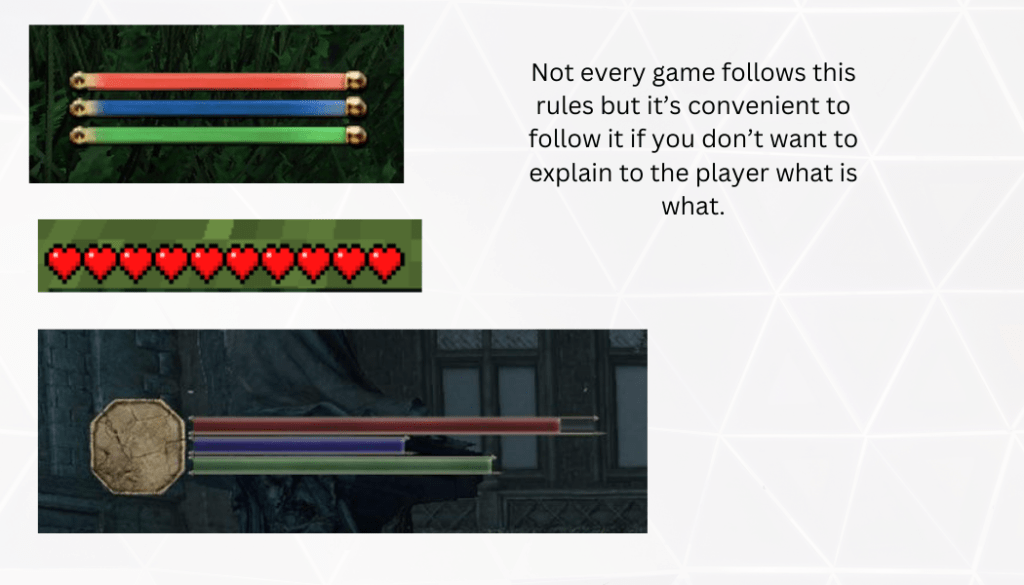
To begin with, I shall describe the most obvious interface markers: health, mana and stamina. In the majority of RPGs, for example, you will be able to see that health bar is always red, mana/magic bar is blue (but it can also mean hydration depending on the genre), and stamina is commonly depicted as green. Just like I have mentioned in the previous post, yellow, theoretically would have fit better being the primary colour but it’s not as graphic as green, so it has been substituted in the main three.
Target markers are commonly white or yellow since they are bright colour and are usually distinguishable, but it’s not always the case. Many times the colour of the target marker is meant to be a colour that would be distinguishable from the surroundings since it shouldn’t be lost on the screen by the player to be efficient.
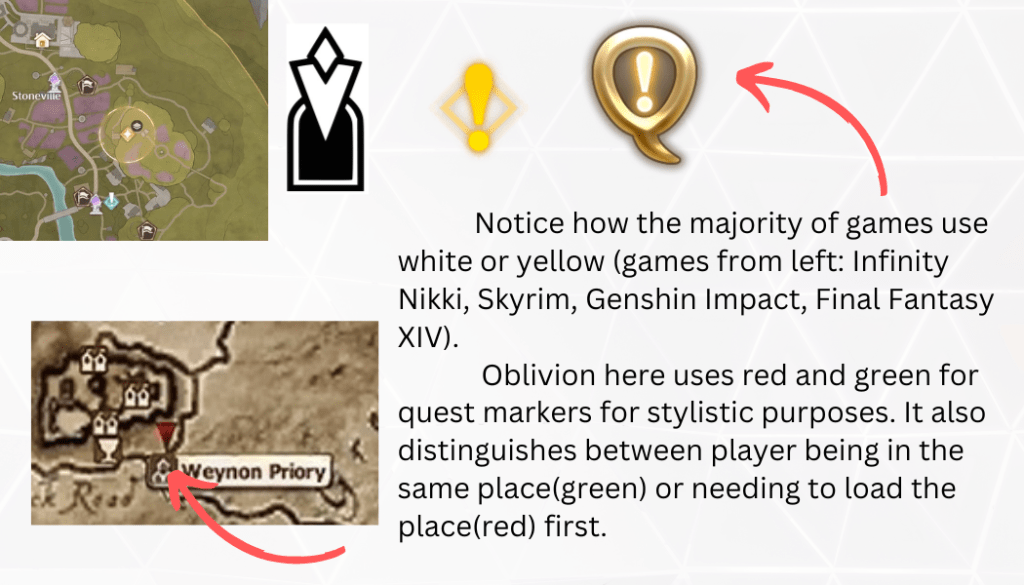
As a little digression on whether to have a target marker in the game or not, I want to say that it depends on the genre. If the game is linear, then it’s not really necessary to add one, but if the game has got many branching paths or any kind of an open world, it would be better to include a marker for players. It can be just a toggleable option in the menu if you are old-school but it should be there. It doesn’t make players dumb, it makes those who have got limited time more efficient.
Nature Markers
Another group of colour references that should be mentioned is nature elements. These are intuitively understandable but I will still give a list of them, since I want to create a full picture of reference (as full as I can, at least):
- Plants – green████ (flowers – pink████): it’s simply obvious. I can also add that dry verdure will have yellowish████ hue and the dead plant are brownish████ in colour.
- Fire – red████, but it can also be orange████ and yellowish████. However very hot fire, for instance, in furnaces can be almost white████.
- Earth – brown████. Most commonly it’s brown, but to show dryer land, red████ can also be used. Orange████ is used for sand, or some desaturated yellow████.
- Water – blue████. Technically the colour goes from transparent and baby blue████ to almost indigo████ colour based on the depth of the water.
- Ice – light blue████, actually, very reasonably known as arctic blue████. Alternatively, celeste████. Ice can also be more white or transparent if the game has got a more realistic style.
- Wind – white████ or silver████ in many Western depictions, commonly turquoise████ if we talk about Eastern games. It basically depends on what you are doing with the wind. If its simply part of the surroundings, it can be white but in games like Final Fantasy and Honkai: Star Rail, where the wind is one of the magical elements, giving it a bit of colour wouldn’t hurt at least for visual presentation.
- Poison – green████, it can also be purple████. I’m not sure when exactly it started but this is the general idea. Poisons are depicted as bright green████ or yellowish green████. It can be purple since it’s the colour of evil as I have stated above, so be aware that if your game has both, abyssal power and poison, it may be a good idea to distinguish them visually in order not to create confusion for players. On the other hand, it can be used to trick players into confusing one with another.
Quality Markers
The last common marker I want to talk about today is the quality marker. It doesn’t need to be in the game but it does help visually explain how rare the item in question is. Items with one star are among the most common items and with seven stars are the most exclusive and hard to get items. Here it’s also important to note that a game is not required to have every item tier, but the majority of games, if they use them many times don’t go beyond the 5⭐ tier. Gacha games usually prefer to cap at 6⭐, but there are always exceptions to the rule. For instance, AFK Journey goes to the seventh tier, Reverse: 1999 goes to the sixth tier, Hoyoverse’s games and Infinity Nikki go to the fifth tier. It’s worth adding here that if a game has started with one system, it doesn’t mean that it won’t more higher during the course of its development.
The list of tier colour code:
⭐ – grey ████
⭐⭐ – green ████
⭐⭐⭐ – blue ████
⭐⭐⭐⭐ – purple ████
⭐⭐⭐⭐⭐ – yellow ████
⭐⭐⭐⭐⭐⭐ – red ████
⭐⭐⭐⭐⭐⭐⭐ – white/rainbow ████
As a little disclaimer I want to say that not every game uses this scheme one to one but the majority of titles remain true to this colour code.
For now, this is everything that I will say about colours in video games. There is a lot more that can be discussed here, but this is not the only topic of my blog after all. In any case, thank you for reading. I made this post because I figured out how this information was kind of scattered around the internet and I wanted to sum it up in one place.
 Geeky Nerd
Leave a comment