Today I would like to introduce you to a little fun linguistic activity that I decided to make with the Devotee Language from the game Chants of Sennaar. It’s the first puzzle-langauge in the game, but, please, be aware that the post will provide spoiler of the puzzle solution.
I have given a little overview of the game before, so I won’t repeat it again.
Main Features of the Devotees’ Language
Here I shall provide some general features on the Devotees’ language, so you can better understand it’s structure:
- The language has got the SVO sentence pattern, which means that the structure of a sentence goes as follows: Subject – Verb – Object; e.g. I go to the garden.
- It’s radical-based. Essentially, it means that each element of a glyph is a radical or a key, as I will call them, with a semantic meaning which forms part of the meaning of the whole glyph.
- The language uses repetition for plural. Like some Asian languages like Chinese or Japanese, this invented language also draws a glyph twice to indicate plurality.
- No “to be” verb. It’s simply omitted in speech. A bit similar to Russian which doesn’t use “to be” in present, but in the Devotee’s language it’s also omitted in the past tense, so the tense is generally guessed from the context.
For those wondering, I prefer the term key over radical simply because I have been interested in Japanese for a long while and this is the term that is used to describe hieroglyphic elements there. I will do my best to write Radical, though, simply because that’s the word which is preferred in English.
Pronouns
Like many other languages, Devotees’ language in the game also has got pronouns to talk about people involved in the conversation.
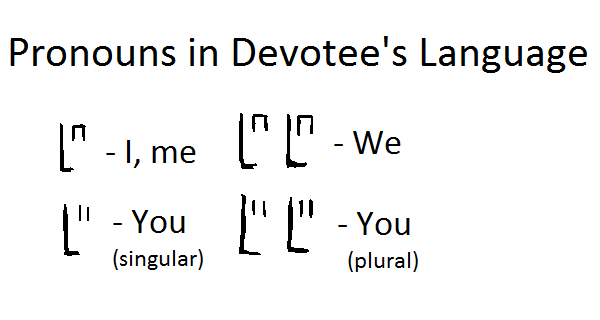
As a result, this means that the phrase:
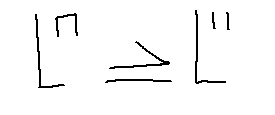
Can be translated as “I love you❤”.
Derivative Radicals
To continue with, I would like to introduce you to the derivative radicals in Devotees’ language. These eadcials are used to define parts of speech (e.g. noun or verb) and categories of words(e.g. places or objects).
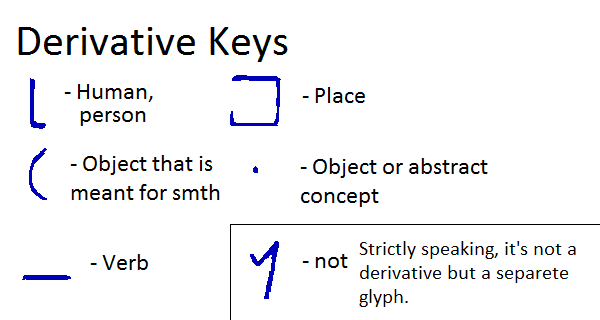
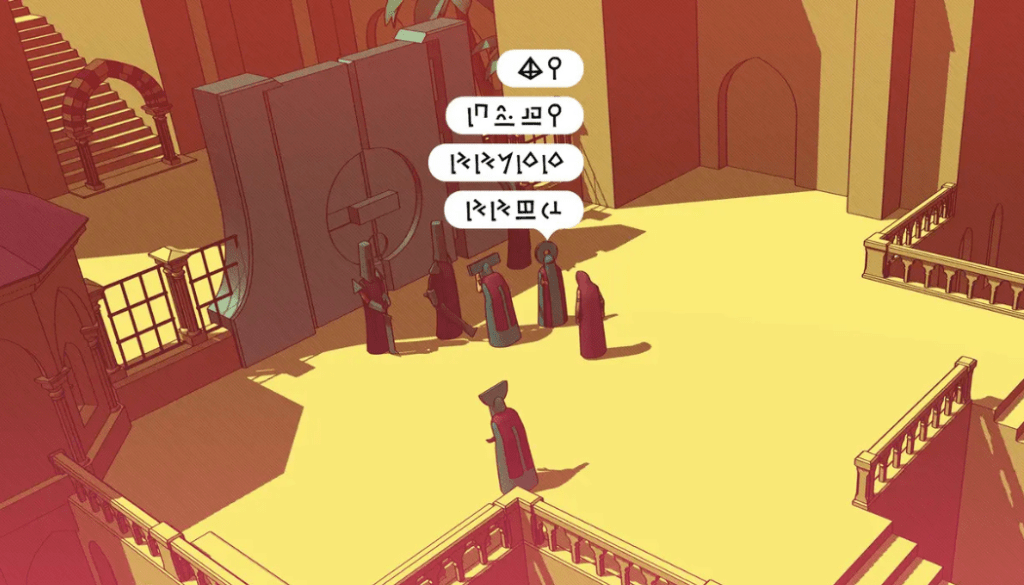
As I have written on the picture, “not” is not a derivative radcial but I wanted to add it somewhere as it is one of the glyphs used in the game, so I’ve added it here. Its use in game looks like this:
Semantic Radicals
A larger group of radicals that shall take the majority of this post is the semantic radical group. It deals with the denotation of the word meaning.
Please, allow me to stray away from the subject for a second. A meaning of a word has got two parts: denotation and connotation. Denotation is the primary or literal sense of the words, while the connotation is the shade of meaning. For instance, “tiny” has got the denotation of “small” and connotation of “extremely or very”, so together the compose “very small” as tiny‘s full meaning.
I have put asterisk near some meanings that I have found to be incomplete or lacking context for a more correct interpretation. The thing is, there are only 30 glyphs in the Devotees’ language that the game uses and some semantic radicals appear only once, which ultimately means that I’ve got only one word to work with to derive the meaning of the radical. It’s simply not enough, so don’t take my conclusion as absolute, I did the best I could with what I had. The result of my analysis you may find below:

In the next sections I shall go over each semantic radical one by one and provide the words I managed to derive from them. I use different colours to mean some specific concepts, namely:
- Red – shows the glyph that I use. The big one is the main radical and its smaller copy is a variation of the writing of the same radical that is usually used as a smaller copy to make the radical readable in a glyph.
- Orange – shows a small copy of glyphs that are not in the game but I derived a simplified desine of to use in some coined glyphs.
- Blue – Marks glyphs that exist in game with their in-game meanings.
- Green – Glyphs that I coined from the derivative and semantic radicals that were described above.
God Radical

I really haven’t got anything more to say here. The only things that may be worth saying it that I’m not very sure about the dot radical. It might have been a part of the radicals it was used in game, but there is no way for me to say for sure.
War Radical
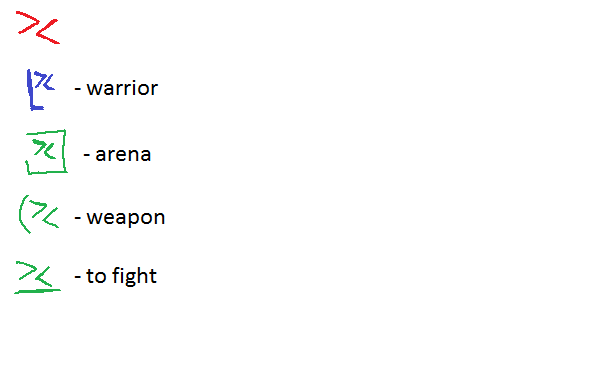
My only comment would be on the “arena” translation. Some may ask why I haven’t chosen “battlefield”. The reason is simple, the key has got a form of “enclosed space” or “a room”, so I thought that “an arena” would fill in this description better.
Speech Radical

I’m sorry if it’s hard to read my handwriting, so I shall write about my doubts here as well: the original word for “preacher” has got two keys – “to speak” and “a person”, but, then, how are you supposed to write “speaker”? I don’t know if it was a limit of the game engine, difficulty or some other factor but in game there is no glyph in Devotees’ language that uses three radicals at a time. You’ll see that sometimes I do it. I don’t know if there is supposed to be a limitation in their language on the number of radicals in a glyph, but since the word to go uses three elements, which, I believe, are all separate radicals, then there is no reason not to use three radicals in other words.
Help Radical
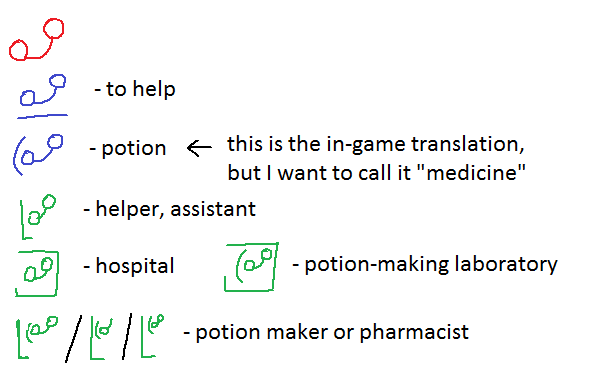
Sometimes I find it possible to simplify a radical in more ways than one but I’m not sure if it’s needed or is reasonable. I mean, there may be other radicals in the language which I don’t know that look exactly like the version I created. In that case, it may create a confusion for people.
Find Radical

I’ve got another word later, that also I decided to translate as “research facility” but it is coined from the radical “to seek”. It’s just the matter of perspective. One focuses on the fact of finding or discovering something new, while the other focuses on the process of searching for something. In addition, judging from this logic, the last glyph I coined can also mean “a discoverer”.
Make Radical
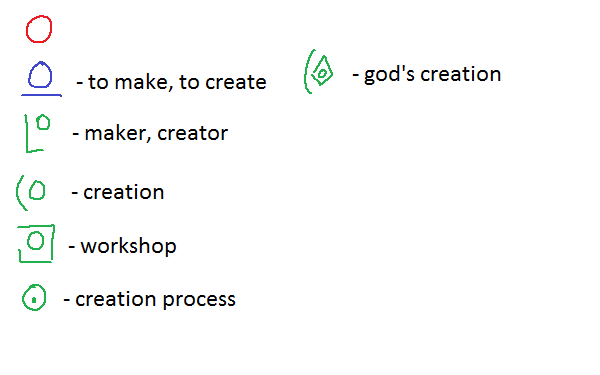
There’s not much to be added here from what I have already said above. The only thing I can add is that I decided to create a separate glyph for “god’s creation” simply because this is a culture based purely on the idea of worship and servitude of to their god, thus, I believe it would be fitting for the Devotees to have such a word in their language as one glyph.
Plant Radical

This one, I believe is quite self-explanatory.
Greet Radical

I really liked this one. I simplified the glyph because it may be to complicated to draw a small version of, other than that, the thought process should be rather self-explanatory.
Free Radical
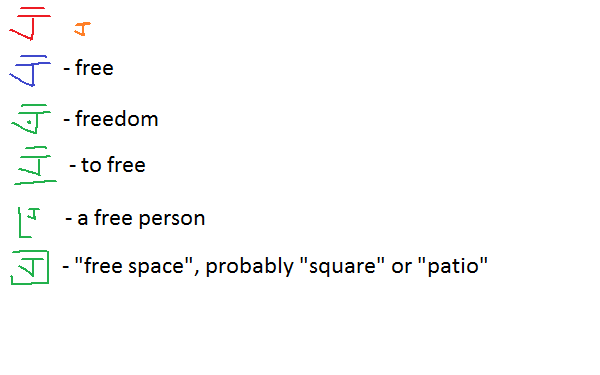
This is the glyph I was quite confused with, so there is not much for me to say here. The only comment I would like to add is that the “free space” glyph may also mean an empty room or any amount of free space in a room. It’s a rather vague concept.
Close Radical
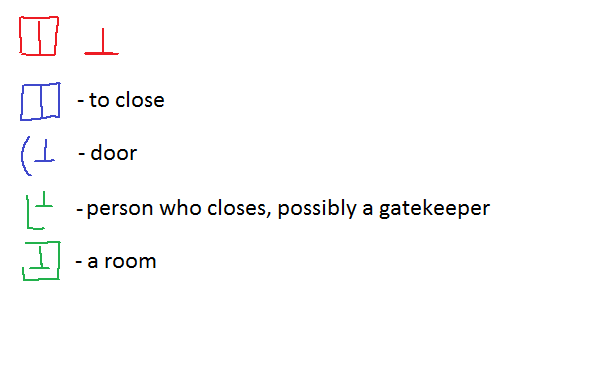
At first I didn’t recognise the “door” key as the “close” variation, but since the key possesses the “open” key, I thought that it was rather fitting for them to be the complimentary pair. A door is closing the space of the room while a key opens it, so to say.
Open Radical

Although, I proposed that the “free” key can be used to mean patio, I’m more inclined to believe it’s the “open” key. There is no support for this claim, though, only personal preference.
Direction Radical
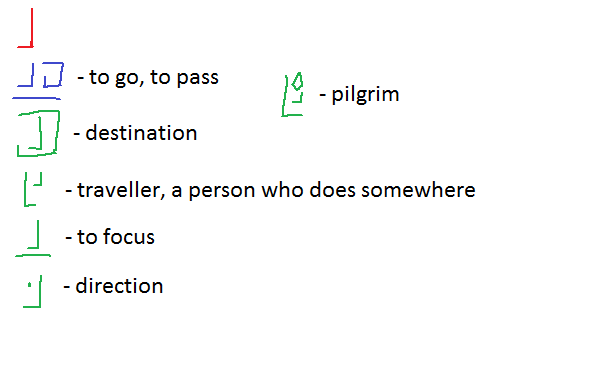
The “to go/pass” glyph was the main reason why I decided to use three radicals in one glyph. Surely, it could have been that the two separate symbols are meant to be one radical but the right radical looks exactly as the “space” derivative key, so I took them separately, which means that the literal meaning of the radicals in the glyph “to go” is “to approach the place of destination” or something along those lines.
Seek Radical

I also proposed to use the “find” radical for the laboratory, but, I believe, that the “seek” glyph would actually be better.
See Radical

About the visionary or overseer, there is not enough context for me to say. Since the original game uses “to speak” key to signify a preacher, perhaps, “a prophet” could be the best translation here, but I lack their cultural context for a more accurate prediction.
Music Radical
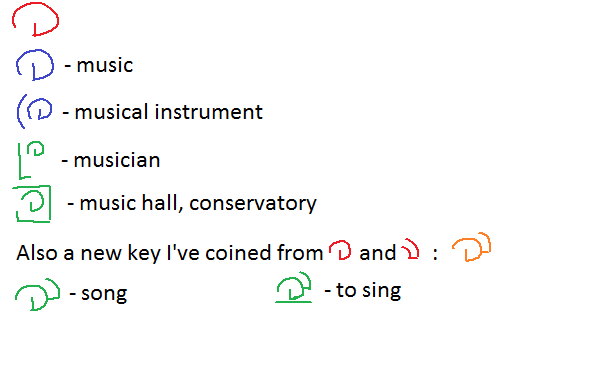
I haven’t tried to coin any other new glyphs apart from the “song” one, but the way the curves of the two keys merged sold me on the idea, so I decided to include it.
Dead Radical
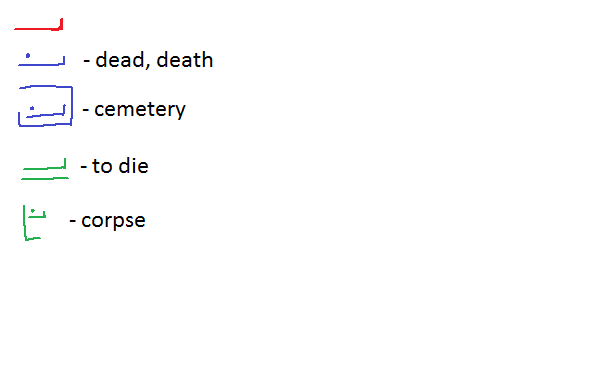
I have my doubts about the “corpse” glyph since the radical for “dead” is literally a lying “human” radical, but I’m including it anyway.
Up Radical
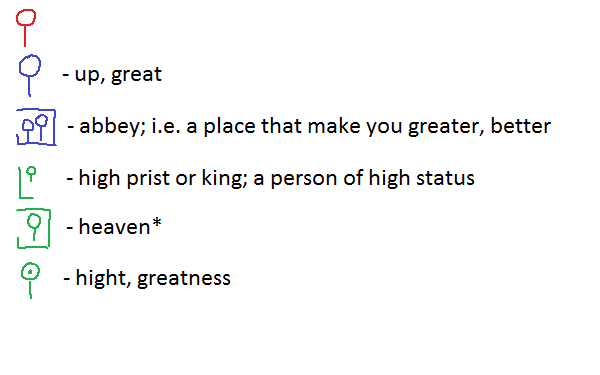
Just like with the “to go/pass” keys before, I’ve got doubts about whether it’s the “up/great” radical or something else entirely. I simply thought that since it’s a religious society, then devotion is considered an activity that makes you better spiritually, so I went with it. Like always, I lack the context for a better judgment.
Love Radical
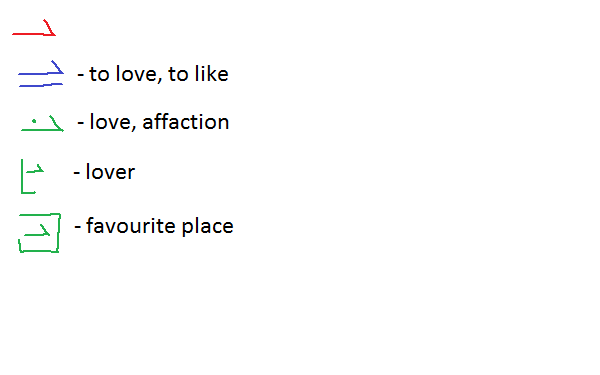
This is rather self-explanatory, so I’ve got nothing to add on this one.
This is all I can say on the Devotees’ language. I would like to make a series of posts on the rest of the languages, so stay tuned if you are interested in it. Also, I would really appreciate if you’ve got any suggestions for the glyphs I proposed in this post. The topic of deciphering meaning of word has always been my favourite. Semantics truly works in mysterious ways. Thank you for your time. It’s been a pleasure writing this post, I hope, it was interesting to read it too.
 Geeky Nerd
Leave a comment