This is already the third post in this mini-series: the Bards’ language. For those who are confused, I suggest starting with the Devotees’ language analysis post, but for those who know the game Chants of Sennaar and want to delve into the language of the seekers of beauty, please, continue. As always, spoilers are ahead, so you’ve been warned.
Language Structure
As always, i will start with a little overview of the Bards’ language structure before describing the specifics.
To begin with, this is the only language in the whole game that uses the OSV pattern. That is, it puts object, then subject of the sentence, and finishes it with the verb.
Bards use pronouns like normal people to refer to each other. I believe, Warriors are indeed the unique ones in this.
Additionally, Bards’ is the only language that we learn the punctuation marks for. Well, the question mark to be precise. It indicates both, negation and question, at the beginning and the end of a sentence.
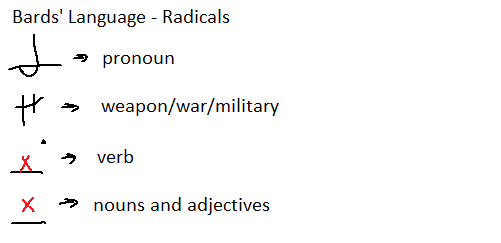
Like the rest of the languages it is radical based, but very few radicals are discernable for this one and unlike Warriors’ language it doesn’t try to imitate shapes of objects it describes, so it’s even harder to discern the meaning of each glyph without context.
With this said, if I have gained some appreciation for the Warriors’ language after properly analyzing it, this one I still despise from the bottom of my soul. It was the hardest to write for some reason and its shapes seem so random I gave up trying to decipher them on their own.
Nevertheless, I was able to dissect a few elements. Her are they below:
Pronouns & Punctuation
There is not much I can say about either, so i’m starting my introduction to the words with them:
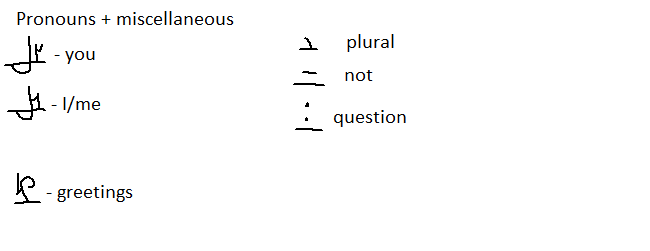
The reason why I’ve put “greetings” in this category is because it was used as an distinct phrase by characters rather than as a part of a sentence, so I cannot say if it can be used in any other way.
Also, since this is the only time we get to see a punctuation mark, a decided to provide a few sentences to showcase how to use them grammatically:

You can try to return to these sentences after getting acquainted with the rest of vocabulary and translate them.
Verbs
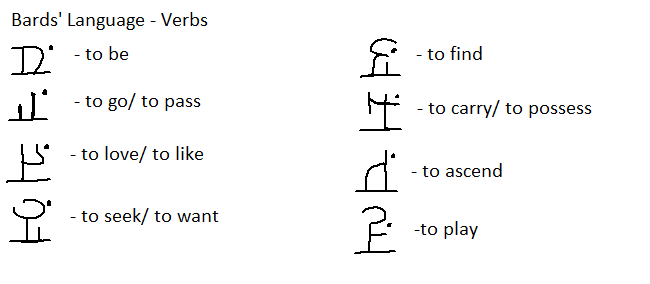
There is not much I can say on this. I like tha fact that the “seek” glyph looks like a big magnifying glass (which may have some lore implications, but I will reserve it for the next part).
Other than that, “go” and “ascend” may vaguely allude to the action they are referring to, but the rest of the glyphs are shapes that don’t repeat in other words provided by the game. However, it is interesting that the verb “to carry/ to possess” uses a radical very similar to that of a “military” one. It may be just a coincidence, though.
Places and Cardinal Directions
I have forgotten to describe it in the section on radicals, but the words that describe places and cardinal directions touch the base line and have got a dot under them.

I find it interesting that the word “fortress” has got the “military” radical in it because it’s a word that in game refers to the Tower they all live on and not some castle or fort.
In addition, the “teatre” glyph has got the same swirly line that we will later see in the glyph “comedy”. It makes me think that this is another radical that is somehow connected to “performance” but I will not draw any certain conclusions, since I lack context.
What impresses me the most, is their cardinal directions glyphs. Surely, in, for instance, Japanese they also don’t correspond to the directions or anything like that. Each of them carries a different meaning, but I’m rather lost with the Warrior radical in the “West” glyph. I suppose, it’s another radical that simply looks very similar, but it does confuse me a lot.
You see, the Bards are located right above the warriors. They are not in any cardinal direction to Bards, but underneath them.
People

I believe, that “monster” can go into this category since it’s also a living creature, but apart from this, I’ve got nothing to add to this section.
Nouns for concrete objects

Surprisingly, the nation that adores music more than any other nations and the game provides the noun “instrument” to mean workshop tools instead of musical instruments.
Also, I have put “path” in here since it can refer to an actual road, but it can be used metaphorically as well, so, please, keep in mind that it belongs to both noun categories: abstract and concrete.
To continue with, I call the radical in “weapon” a “military” radical simply because it can refer to many things connected to warriors. But, yes, most likely its real meaning is “weapon” and nothing more.
Finally, I appreciate how compass looks like the object it represents with a little “arrow” that shows the direction it points to.
Nouns for abstract objects & Adjectives

Well, looking at the “beauty” glyph you may now guess what the plot of the game is about, or rather the main theme of the game. If not, then wait till I finish with all five languages, I will describe it in detail in the last post of the series.
As for why I have put “brother”, “idiot”, and “free” in the same column, it’s because these words seem to be adjectives in the Bards’ language. Yes, the first two can be used in nouns as well, but I have my doubts. If you want to know why I put “brother” in an abstract category, well, its because of the in-game context for its use. In one of translations you make between the two nations of the Tower they call each other brothers, but given how they are separated, and it seems for quite some time now, I can only guess that what they mean is that they are distant relatives. They came from the same origin at some point and belong to the same kin, that’s why the call themselves brothers, not because they are related by blood.
I expected this one to be shorted since I had next to nothing to say, but those few elements that needed explanation took quite some space. I believe, Bards’ language is the hardest one in the game: it’s very difficult visually and since it has got the only distinct pattern in the game it provided additional challenge. It was still a very enjoyable chapter since it provided you a book to read. This experience was an interesting one indeed. Next one is the Alchemists’ language. It’s my favourite. I don’t mind writing like Alchemists in real life as well. It’s a real visual and linguistic treat.
 Geeky Nerd
Leave a comment