It’s already the fourth post in the series, second to last. It’s also my favourite language – the Alchemists’ one. It looks deceptively complicated but unlike the Bards’ language it is actually easier to understand because the radicals that compose its glyphs are very particular and their shapes are relatively easy to understand. As usual, spoilers ahead.
Language Characteristics and Radicals
To begin with, like the majority of the languages in the game it is SVO based (firstly goes Subject of the sentence, then Verb, finally, Object). This may be a conscient choice on the developers part since even though the most common type of sentence structure in the world is SOV(47,5% of all world languages), the SVO pattern used in the game is the pattern of all the deaf languages in the world, which, in my opinion, makes it the pattern that would be easier for the majority of people to pick up. I haven’t spoken of it before because it didn’t fit the languages I was describing but now we are talking about Alchemists, or how they call themselves, Researchers/Seekers, some scientific facts would work well here.
Secondly, it’s a radical based language and it is evident by both grammatical and semantic radicals we will encounter. What’s interesting here is that it doesn’t matter whether the radical is mirrored or reversed, it conveys the same meaning, as far as I can tell, it’s the shape that matters while reading.
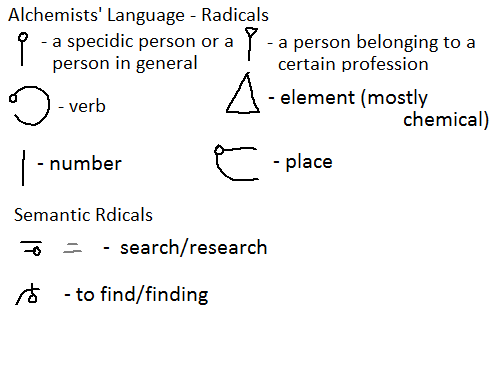
Surely, it’s not a lot but it’s all you need to make some great puzzles. Also, unlike the previous languages I quickly gave up on the idea to draw other variants of the same radical because the main criterion of their form is how cluttered the space is. In terms of being mirrored or not, it depends on whether the semantic radical touches the grammatical one or not. Usually they touch. In addition, grammatical radicals are never reversed or changed, only semantic ones can undergo changes.
Pronouns and Grammar
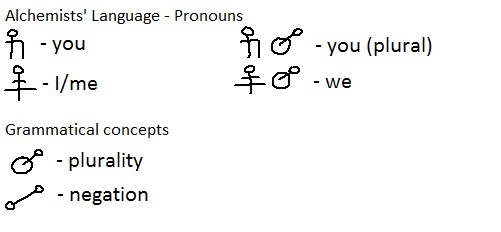
The Alchemists’ language uses pronouns like the majority of the languages in the game but again, we are not given the third person ones.
Plurality in both pronouns and nouns is shown by a glyph behind the word in multiplies. The negation, on the other hand, goes before the word it negates.
It is interesting that the radical in the first person pronoun looks very similar to the “research/search” radical, but it’s not the same thing. Although, it could have been influenced by it due to the isolation of the different nations in the Tower.
Numbers
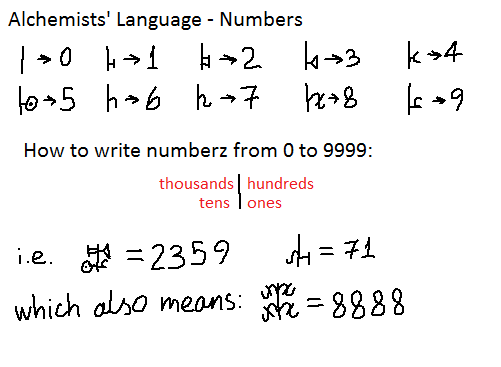
There is not much to say here. It’s the easiest subject, so, I’ve put it before any content words. This system is very interesting but now I wish to know how do they write bigger numbers.
It is also worth noting that since the Alchemists’ language in general was inspired by real life alchemical symbols in Europe, some of its influence is very pronounced in the shapes of numbers. For instance, 5 looks like Sun, 9 like Jupiter, and 7 and 8 like Saturn.
Verbs
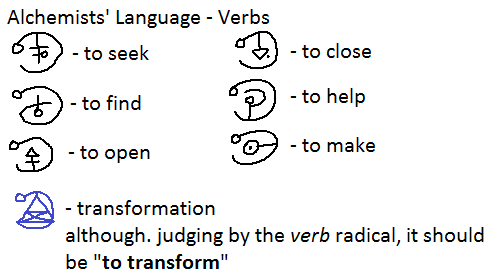
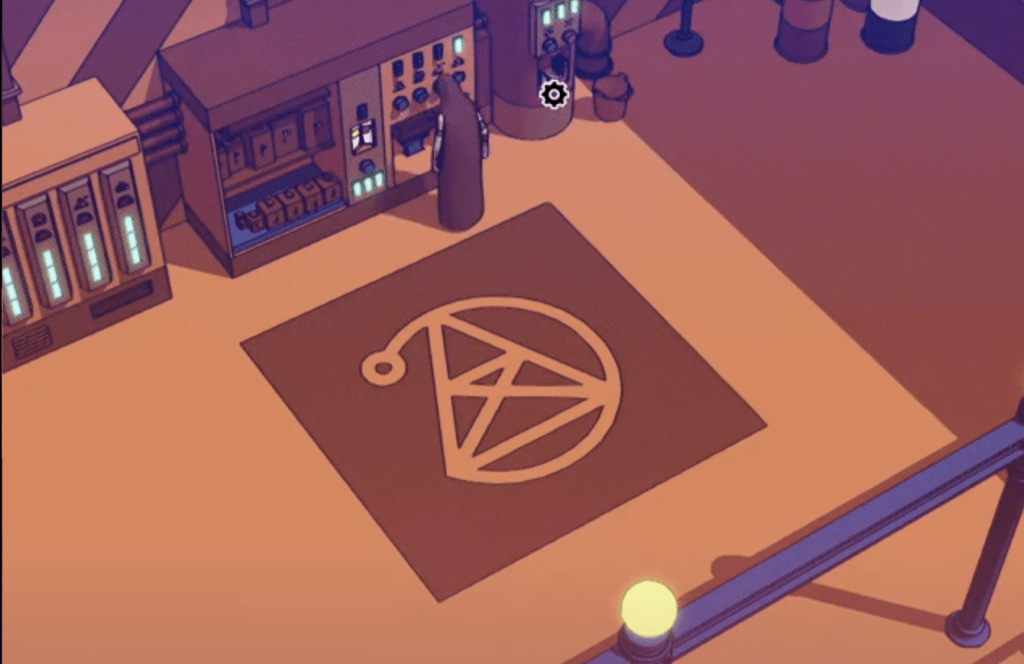
I haven’t got much to say here, but “transformation” is a mystery to me. The game translates it as a noun, and, frankly, while I played it didn’t bother me. Now that I’m deciphering the glyphs and their radicals, I’ve got a question on why it’s a noun. Also, you have noticed the triangular shape that repeats itself throughout the glyph that means the key concept of the nation? Yes, you guessed it right, but more on that in the final post of the series.
As for another glyph that puzzles me just like “transformation”, it would be the glyph that means “fear”:
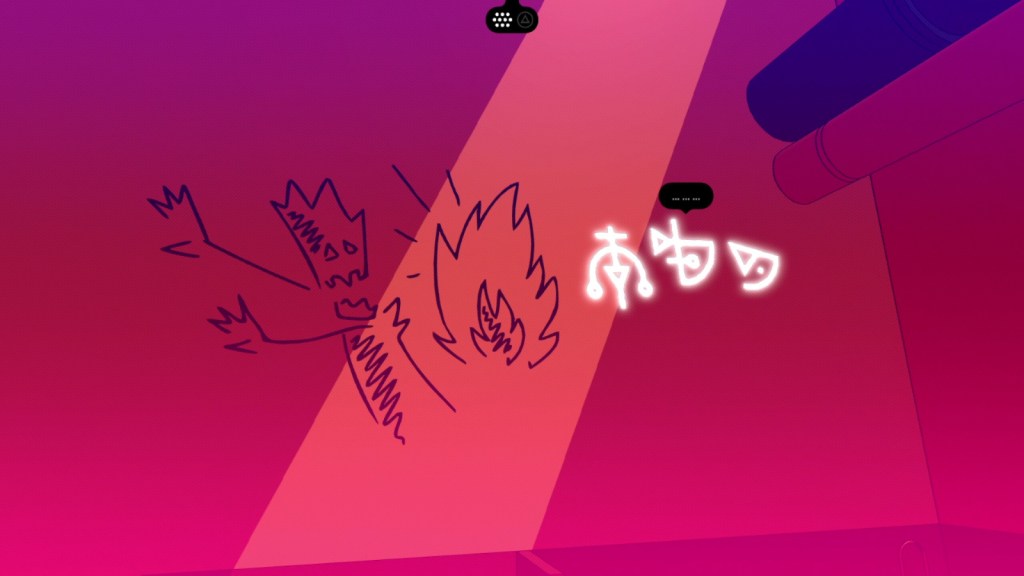
Yes, I know it should mean “monster fears fire”, but that’s the thing, it doesn’t. The word “fear” lacks the radical that shows that it’s a verb, which effectively makes the word a noun. The word may shape the same writing in English, but not in the language of Alchemists, those radicals are there specifically to convey certain meaning.
People

This is rather self-explanatory, but I would like to comment on the fact that the glyph for Alchemist seems to be the only one that is derived from a verb. Additionally, the glyph for monster hasn’t got a triangle above but a line probably to indicate that it’s not a sentient being. I also like how the glyph “brother” shows two people bound together.
Here’s the catch, though, on why I believe that in both, Bards’ language and Alchemists’ language the word means “a relative” rather than “a brother”:
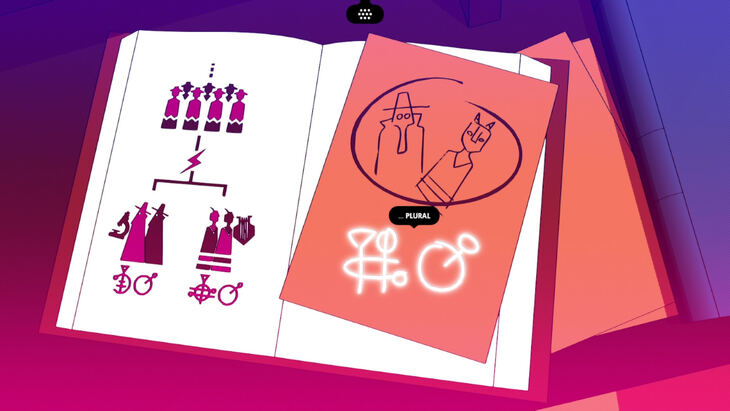
There has clearly passed enough time in game for them to forget about each other and their connection. Any fresco or picture left is damaged from what seems to be time and is usually left forgotten on the outskirts. They have not seen each other for a long time since, judging by their reactions, it’s a discovery to both of them. To me, it feels like at least a few generations had to be separated for them to forget each other like this.
By the way, their connection is teased to us even in the Bards’ land in the fact that they have got a mining facility and a workshop even though their whole culture revolts around beauty and arts.
Nouns & Elements

I’ve already said all I could about nouns, but I find a couple of peculiarities in the element worth some attention.
Firstly, the radical in “profession/particular type of person” has got a triangle which is the defining radical for an element. Perhaps, the triangle is generally meant to represent the idea of belonging to the same category or kin depending on the subject at hand?
Secondly, the radical in “silver” is the same as the radical in “fairy/anchorites” or more commonly, “the exiles”.
Places
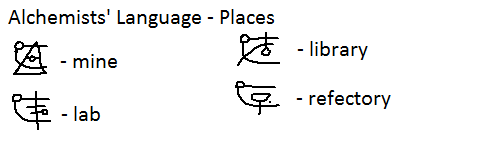
There seems to be a common method of creating glyphs of places and that is to take the radical of place and of a verb. That is to say, each place is a place where you do something. “A laboratory” is “a place where you search/research”, “a library” is “a place where you find (information)”, and so on.
Using the same logic, the “mine” glyph should basically mean “a place where you mine/excavate/get elements”.
Coined words
Using the words above I have coined a handful of glyphs myself. They follow the rules set out by the glyphs in game. There can also be other variation or translations to them, but that is all I could come up with:
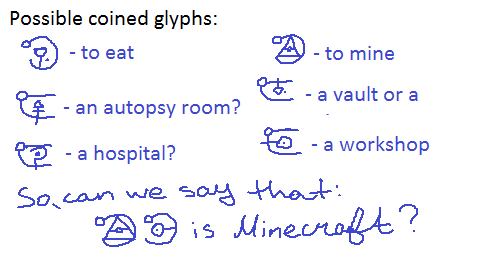
Oops, the middle glyph on the right is meant to say “a vault or a prison”. I’m sorry I was rather tired when I drew it. Again, I was using the logic of a place being coined from a verb: “a place that is used for closing (something or someone)”.
Also, yes, the Minecraft glyphs are mostly a joke, please, don’t take it seriously.
In any case, thank you for reading this post. It was very enjoyable to make, hope it were as enjoyable for you to read. The next post shall be the final one in the series and then I will continue with the content as usual. See you in the next post.
 Geeky Nerd
Leave a comment