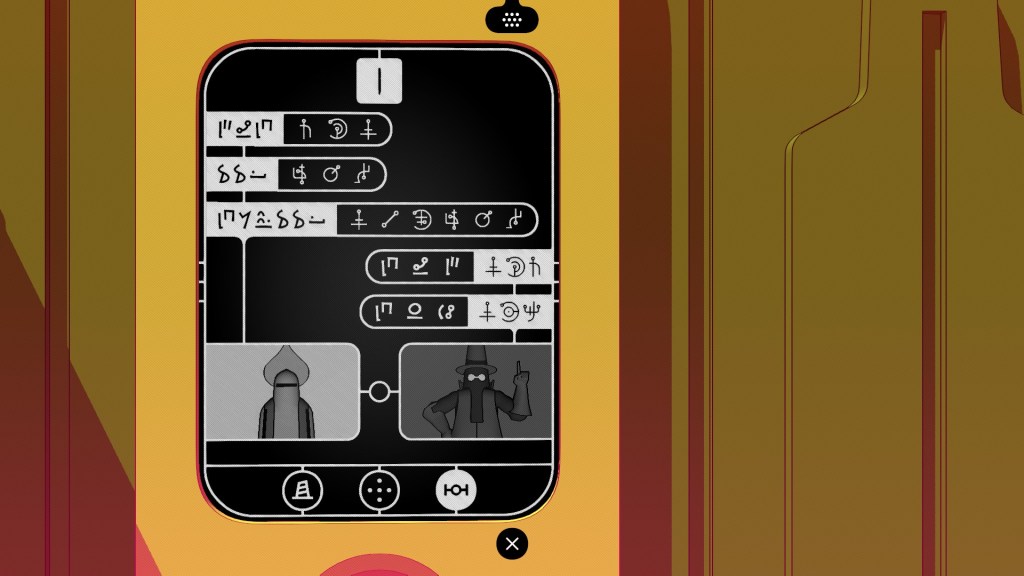
Alright, this is the final post on the Chants of Sennaar languages. This one is about the Anchorites’ language. These people are also known as the Exiles and I may refer to them as such at times. This is the final language and it’s acquisition in game is much faster than with the previous languages and I’d say is far less organic, but is the part where you learn the global plot of the game, which I don’t want to spoil here. Either way, the task of this chapter mostly consist of translation and I may argue that this is the language that is the least developed in game compared to the rest. It’s far more structured than many, but at the same time I hesitate to call it a good system. Nevertheless, more on that later.
Language Features
First things first, it’s another language that uses radicals, but this time a bit differently. This time the process looks very akin to agglutination.
Agglutination is a grammatical process in which words are composed of a sequence of morphemes (meaningful word elements), each of which represents not more than a single grammatical category.
Taken from Britannica – link to the article
If it’s hard to understand from these words, please, continue with the vocabulary and you will understand exactly what I mean.
However, as of now I would like to present to you a list of radicals that I have found:
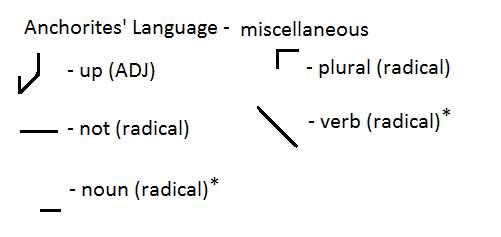
The two radicals with the asterisk are the ones that I have got some doubt about, at least the noun one. There have been introduces very few nouns for me to be certain about it.
As for some other language features, Anchorites’ language uses the SVO (Subject, Verb, Object) order in the sentence like the majority of the languages in the game. Bothe plurality and negation, as you could see from the picture above are made by adding a morpheme in the same glyph, which sometimes creates another word which creates even more problems, in my opinion, and I will explain why in the subsequent sections.
Pronouns
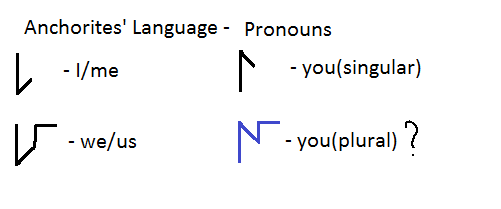
There is not much to comment on in this section. These rules are plain and simple. I’ve put a question mark next to the second person plural pronoun only because it wasn’t included in the game, but this is how the Exiles’ language uses this radical, so it should be correct.
People
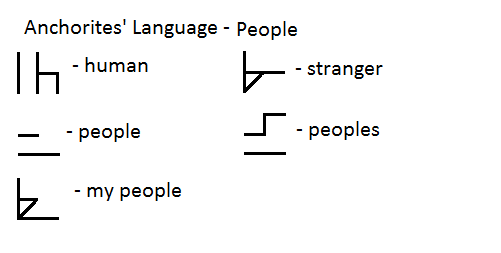
You can see here that the word for “peoples” is the same as “people” with a “plural” radical. I’ve noticed it a bit too late to change it, but it’s a significant example of how confusing the system can get. In the game this word is used to refer to the different “nations” whose languages I have described previously, and here it is derived from a noun that already possesses a plural meaning.
Yes, there are languages where “people” is singular, for instance Spanish word “gente” translates to English as “people” even though it’s used with verbs in singular in Spanish, but this one is different. It changes the whole meaning of a word to a different one. I wonder how it’s explained in the culture of Anchorites, because it’s clearly very different from what I’m used to.
Nouns
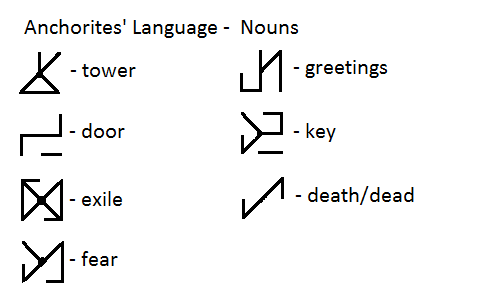
Technically, the “greetings” word should have gone to the miscellaneous category because it’s more of an interjection or exclamation rather than a noun, but for some reason I decided to put it here.
The “death/dead” glyph is the main reason why I doubt my attempt to understand a radical that denotes nouns – it’s both a noun and an adjective, which may be significant for the Exiles, but it’s hard to guess.
Also, I believe the “exile” is the most important word for the Anchorites, I mean it’s in their name, so it may be time to show the true ending:
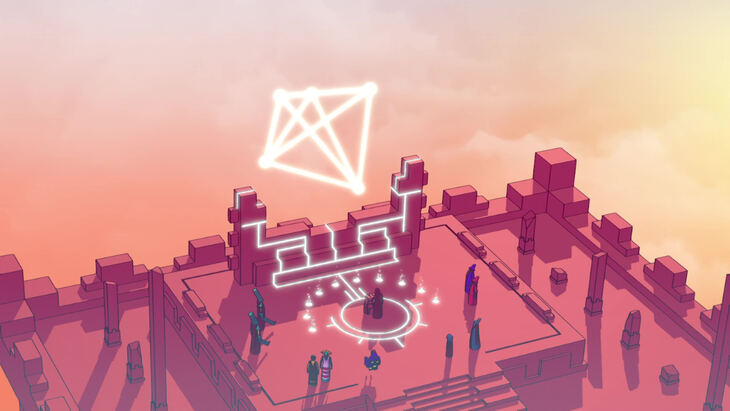
This shape in the end at the top of the Tower shall change it’s shape from God to Duty to Beauty to Transformation to Exile showing how all the nations on the Tower were all seeking the same thing even though they all had different names for it and different understanding of how to get it. I love this ending since I find it quite poetic and very real.
Verbs
I could have waited for the ending to be in the end of the post, but this is not a game review but a language analysis and in verbs it basically reaches its culmination.
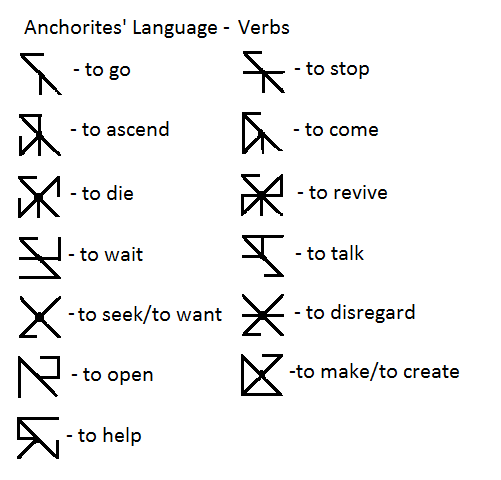
You can see how the radical “not” is cleverly used for the verbs “to stop” and “to disregard” as these ideas are opposed to the verbs “to go” and “to seek/want” but, then, there is “to revive”.
I’m sorry but “to not die” and “to revive” are not the same concepts, yet their writing is supposed to be the same. This part of the Anchorites’ languages is the most confusing one for me. It’s not so bad with nouns only because they are not as cluttered as verbs, but still this lead me to the main issue of this language:
Possible Problem of Anchorites’ Agglutination
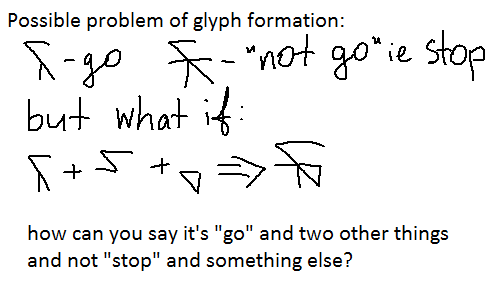
I’m not sure if you can even combine three radicals in one glyph, but the question still stands. There is no way of seing the parts of the radicals that intersect with each other, then, what if two radicals shall look like another radical even though the glyph shall not take the meaning from this third radical they accidentally resemble? I mean, the whole language works on a very simple grid:
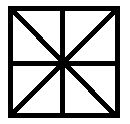
All glyphs in the game follow some parts of this grid and the rest is just left blank. This is, by the way, how I drew the glyphs this time.
Additionally, this is the reason why I wonder if it’s possible to combine more than two radicals in one glyph. How many of the glyphs in Anchorites’ language are actually homographs? I can only imagine it being solved by different pronunciation in speech, but what about reading?
What I want to say here is that it’s a great puzzle for a game but, alas, not a working language system. It looks exceptionally well, I love it, but such a small grid cannot squeeze a whole language inside it. It may be possible shall the grid have smaller segments, though. After all, we as players learn only a handful of words and it can just happen that they all have got big shapes while the majority of the words in their language use a far more detailed grid than the one I drew above.
Either way, this is all from me for now. I have completed the language analysis of all the languages in the game Chants of Sennaar mostly because I greatly love the game and I wanted to learn more about its language systems. It was a fascinating journey through some distinct and intriguing language systems. I thoroughly enjoyed it and, I hope, you did as well. Thank you for reading.
 Geeky Nerd
Leave a comment