This post shall talk about the importance of structure in a story. The structure I shall talk about is based of the Joseph Campbell’s theory of the hero’s journey – a cycle through which the protagonist goes through as the story progresses. I shall describe the chief ideas of the three part structure based of the hero’s journey, then I shall briefly explain the hero’s journey of the principal Minecraft Movie characters and the main folly of modern story telling.
What is the Joseph Campbell’s Hero’s Journey?
To visualise, I would like to provide this diogram from the Joseph Campbell’s Foundation website:
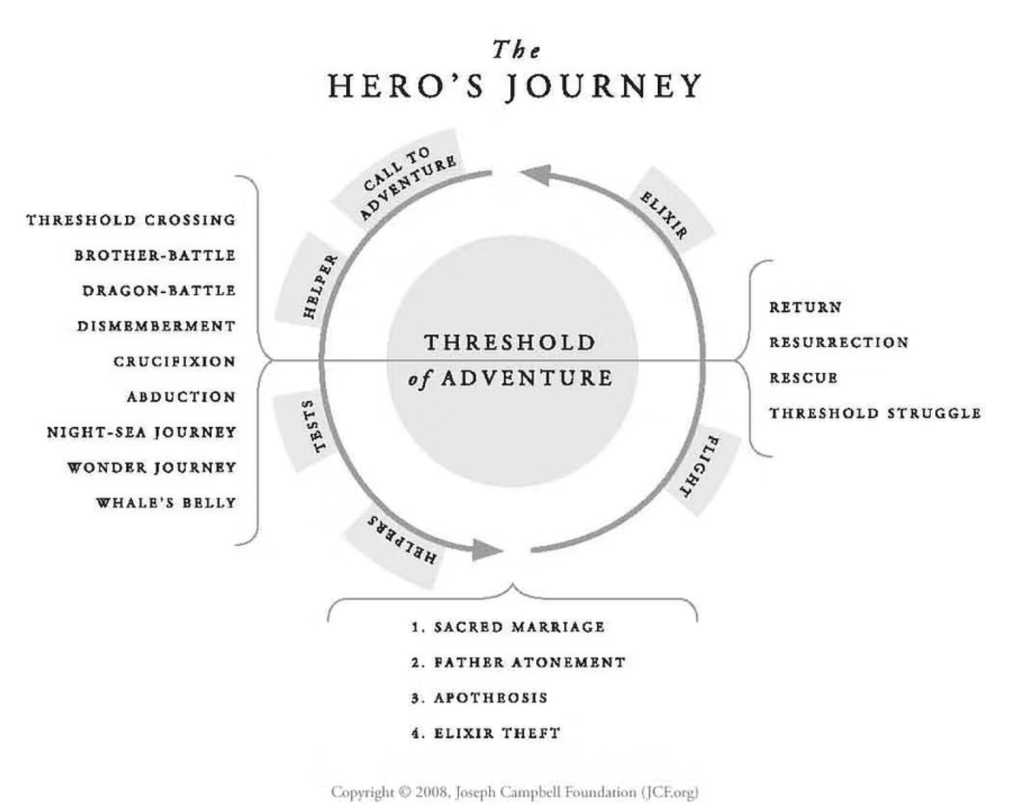
The picture above basically demonstrates the plot structure of the majority of Western stories. I would say specifically Western because I am not that familiar with Eastern storytelling but I know that it has its own specifics which make it different.
Either way, the cycle starts with the call to adventure, which is usually connected to the main conflict of the story. It ends with the resolution of the said conflict.
Why it’s important for the story’s structure
To begin with, a logical structure is easier to follow than actions that jump chaotically from one to another. In a traditional story all actions have got consequences and the said consequences lead to the reaction which transforms into further action and so the cycle continues. This is how real world works as well, so this way of telling a story provides simile which is important for audience’s comprehension of the plot.
Furthermore, it provides a sense of understanding and may help build anticipation as common patterns shall be recognised by the audience. Whether to follow or break those patterns is for the author of the work, since playing with expectations can be both detrimental or rewarding for the story. All I can say is that understanding these foundational principles is essential for the author because if you break the foundation, you ought to provide a good substance for it.
Act I: Setting the goal
This is where the author is supposed to introduce the main characters of the story and describe the goal of the story’s protagonist. The setting of the goal is what is called “The call to adventure”. In some stories it follows by a denial of the call by the protagonist due to the fear or inexperience, but not all stories include it.
This is also when the protagonist is introduced to his/her helper or mentor who guides the protagonist through the journey. This figure is important because a journey in its broadest terms means to travel into the unknown and its extremely difficult to do without having a “local” guide by your side.
This is also when the world is introduced and in modern terms, where the world-building happens. This sets certain expectations by the audience, since, if they learn about certain rules in your world, the audience would expect all the characters to follow the set rules. This part of the story can also help you determine whether the character before you is a Mary Sue or not. (They bend those rules like it’s nothing! Truly the worst trope of modern storytelling)
Act II: Achieving the goal
This part is the main “meat” of the story, it’s all the adventures, trials and lessons that the hero must go through to reach the goal.
However, an author shouldn’t add anything in this part. In my review of the Robin Hood cartoon I mentioned how every scene would sets up further characters or actions. This is how the story should work. Looking at it now really makes me want to revisit one of the fairy tales I have once wrote to redo certain scenes. A process so many forget about nowadays.
Regardless, this should still be the most creative part of the story. The setup is something that is easy to pick up and the resolution is usually clear since traditional stories, if not tragedies, have got a happy ending, but how the hero gets to the “happily ever after” is what matters.
I am a strong believer that works of art, be it books, films or games should teach good and provide decent examples of behaviour for real life. That’s why I don’t really mind boring generic protagonists. It’s their purpose to be good. At the same time, I enjoy it when stories contemplate less common situation and delve into the grey morals, but this becomes very tricky very quickly. I will not delve into that in this post since it’s a very controversial topic and deserves a deeper distinct discussion.
Act III: Resolution
The final act that serves as the conclusion of the story. It tells the audience what were the consequences of the journey and how they affected the protagonist. In traditional stories it’s usually a happy ending when all the problems are resolved and the hero can rest (and/or prepare for the next journey). In tragedies, it’s usually the part where everyone dies or at least the story doesn’t end well.
Hero’s Journey in modern storytelling
Partially, Minecraft Movie was the reason why I decided to write this post, but not the main one, it served more like the final drop before it became the issue I cannot avoid anymore.
Yes, Minecraft movie does have a distinct protagonist with a distinct purpose, gets the experience and a good resolution: The journey in the Minecraft world helps Garett Garrison admit that he is stuck in the past, so he decides to finally move forward. But! But the story doesn’t focus on him. It switches between three characters who the story wants to talk about:
- Steve, since he is the main Minecraft character;
- Garett, the classical hero who goes through an actual cycle described above and
- Henry, the modern protagonist who doesn’t need a cycle because he is perfect the way he is, it’s the world around him that needs to change and accept him for what he is.
I can see that the story was struggling to pick its protagonist which left all stories clumsily stitched together. Yet, I find it ironic, maybe, poetic, that the older character follows the older way of storytelling, while the younger character falls to the folly of modern storytelling: no development and being the centre of the world.
I’m sorry to bring it to the modern storywriters, but the Sun doesn’t revolve around the Earth, it’s the other way. The protagonist is the one who should be part of the general plot, design, fate, if you want.
Some may say that I just don’t like that the modern storytelling is different from the traditional one that I prefer. But here is the catch: Henry shows the main folly – he’s a Mary Sue. What’s the problem with Mary Sue’s? They drain the conflict dry. If the rules bend to every Sue’s whim, then there is no tension and the story becomes plain. It also means that the story cannot teach how to overcome difficulties or anything basically.
Surely, the story doesn’t always need to teach, but how can a story entertain if you’ve got a “god” in the thickest plot armour against ordinary characters?
As a closing remark I wanted to note that I don’t critique storytelling of the Minecraft Movie. Well, a little bit yes, but it’s not too critical, simply unfocused.
As for the conclusion, I just wanted to say that if you create a story it’s important to understand what the story is about. The ending should always have a payback for the expectations set in the beginning. Another key detain is remembering that every story builds of conflict and tension. If you lack them, then, the story may seem engaging to the audience since there are no stakes involved.
I’m sorry for not writing for a long time, I needed a break, it seems, but I’m back and I’ve got some ideas. Thank you for reading.
 Geeky Nerd
Leave a comment