Today’s post will be a short review about a Disney animated film from 1963, The Sword in the Stone. It’s a retelling of the Arthurian legend about how Arthur got the sword from the stone. The sword was meant to symbolise him as the true and destined king of England. However, this interpretation creates a more modern take on the story, well, modern for its time. Nonetheless, it’s message is relevant to this day and most likely will never cease to be relevant but first things first.
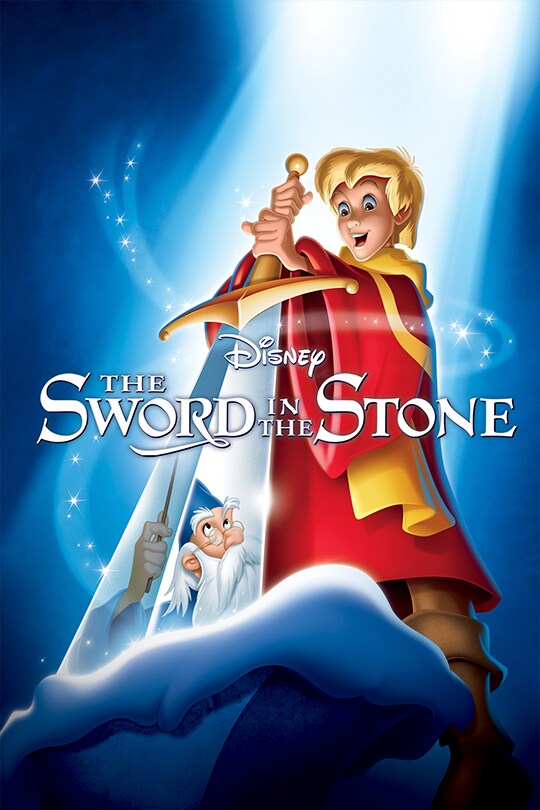
What the plot is about?
The plot follows young orphan boy named Arthur who serves as a page in an old English castle. By chance, or rather, by fate he encounters a powerful wizard in the woods whose name is Merlin.

Merlin lives in a small cottage in the middle of the woods with his owl familiar Archimedes. From his introduction we can learn that he has been to the future and knows great many things including Arthurian legends and he is aware of his role as young Arthur’s mentor in this tale.
He returns to the castle with the boy where he is given a cold shoulder by the host, Sir Ector, at first but convinces to let him stay with a couple of magic tricks. Merlin is offered a spot in a run down tower of the castle but he doesn’t mind as long as it means being close to Arthur.
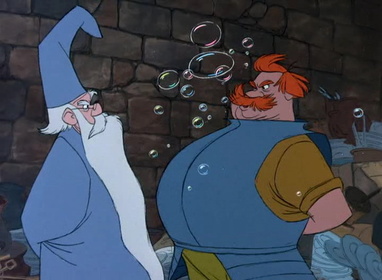
After that we are introduced to a plot point which introduces several moments of tension to the plot but in overview I can say that there is no great conflict in the story, only some situational tension. Mostly because we, as the audience, already aware that Arthur shall become the king and it’s only a matter of time how. But it still provides an interesting conflict between the characters and raises some interesting topics for discussion.
The event I’m talking about is the arrival of Sir Pelinore. In this retelling of the story king Uther died without leaving an hier, but a sword in the stone has magically appeared in London. On this sword there are words that only the true king of England can take it out. Of course, many have tried and failed. Thus, Pelinore comes to tell his friend that a knight tournament shall be help on Christmas to chose a new king, since, well, a country cannot exist without a ruler for long.
After that Arthur is torn between receiving lessons from Merlin and trying to serve Sir Ector, so he can be his son’s, Kay’s, squire. Merlin is not inspired by the perspective of Arthur serving some idiot (and trust me, idiot Kay is) and does his best to educate young Arthur about how life works and how knowledge is the real power, not muscle.
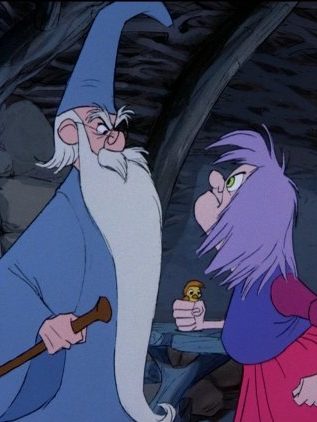
It seems that he wins the boy’s attention fully after Arthur’s accidental encounter with Madam Mim, an acentric evil witch living in a boggy area in the woods. They hold a magic duel where Mim breaks every rule set but Merlin still outsmarts her by becoming a bacteria and making her ill.
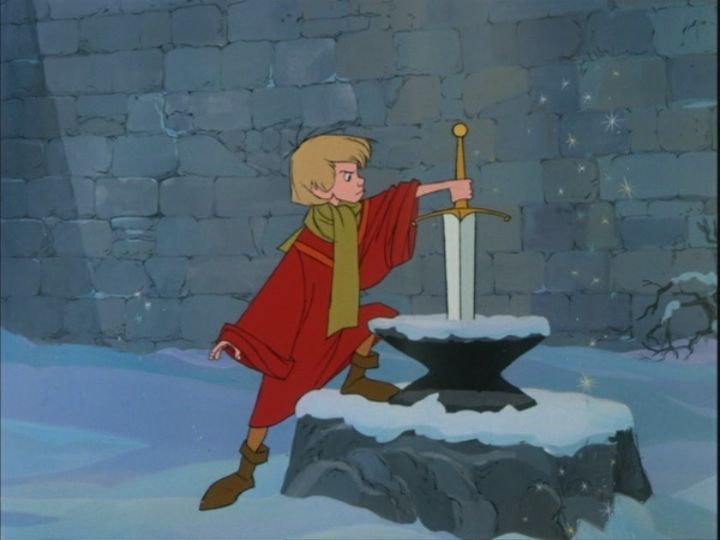
The story began in July, and ends about half a year later in December where Arthur, though not without trouble, goes to London with Sir Ector and Kay as his squire. It’s during the tournament that he remembers that he forgot to bring Kay’s sword with him and rushes to the inn. Alas, everyone is gone to watch the tournament and desperate Arthur notices a sword in some sort of anvil. yes, it’s the sword in the stone.
Old Film, Relevant Themes
One of the main topics that I haven’t noticed when I watched this film as a child but was very evident to me as I re-watched it for the review is the importance of education. Yes, nowadays it’s common to be dissatisfied with education and saying that it’s relevant experience that matters, but from my master’s I’ve learned that it’s not the practical stuff that education must give you, it’s the theory. You should use your own brain how to use that theory in practice, use your creativity so to say. This was one of the first lessons Merlin taught Arthur.
It was even a question that Arthur asks Merlin when he explains that he goes to the castle to tutor him. Arthur asks why he needs an education. To it Merlin elusively answers that he should get one first and then question it. It’s easy for me to say “go and get an education”, but I know that it’s not affordable to anyone. All I can say that getting one is definitely worth it even if you wouldn’t get much from it. It broadens horizons and teaches you how to systematize information that you receive. It helped me working with documentation and generally analyse what anyone tells me.
Another relevant idea I have mentioned briefly is the tension between Merlin and Arthur where Arthur was happy to be a squire while Merlin saw it as a waste of time. This is the conflict of a pragmatic and an intellectual, for a lack of a better word. Literally, I forgot the word I was looking for in every language I know.
Please, allow me to explain, Arthur is being pragmatic in his desire to become a squire. For an orphan it’s a great opportunity to boost status in medieval times. He’s right in doubting Merlin’s proposal but Merlin is there to provide opportunity. Opportunity alone is not enough for a person to flourish, you also need courage to seize the moment and wit to do the right thing to get the outcome you want.
Old Film, Old Animation
Before I end this post, I want to say a few words about the animation. There was a couple of scenes that repeated shot by shot which shows that the budget was rather small. Yet, the quality of the writing or anything really didn’t drop one bit. Even the repeated frames don’t look cheap. In addition, the drawing of the background are stunning, especially the introduction to the story which looked like a legend written in a book and sung to the audience. It really sets a magical tone to the tale.
Overall, the drawing style looks unique and fluid. The drawing are stylized and a bit cartoonish which makes face expressions and postures feel full of personality. The humour doesn’t fall behind either.
All in all, it’s a very light-hearted tale which can be entertaining for both children and adults alike. Watching this film was definitely a time well-spent.
 Geeky Nerd
Leave a comment