Last time I posted I felt like I sounded too boring ranting about Gen Z and lack of etiquette, little did I know I’ll be “preaching to the choir” in a couple of weeks. Yes, today I would like to talk about the latest Sony Animation film that came out in June this year – Kpop Demon Hunters. The film became a hit almost instantly and for a good reason – it’s an inspiring tale which highlights modern problems and concerns, so the characters and the story are very easy to connect to. As much as I want to talk about how visually clever and fresh its style feels, this post will be dedicated to Christian symbolism which I was able to find going like a golden thread through the narrative.
To specify, this time I will only talk about narrative symbolism, the lyrics of the songs deserve a separate post. Although, I will slightly touch the important themes that the songs highlight.
The plot
The story follows The Huntr/x, an extremely popular kpop group which consists of Rumi, Mira, and Zoey. Yet little do their fans know is that with their songs the girls are also fighting demons and protect the world from misery. However when the team got to close to the goal of sealing the demon away forever, one cunning demon came up with a plan to foil Huntr/x’s goal by creating a demon boy band and weaken the source of their power – their loyal fans.
Since the film is rather recent I won’t spoil all the plot here and advise you to see the film for yourselves before continuing because now I would like to talk about the religious symbolism that I have found rather interesting. I don’t think that it was put there by the production team, at least I couldn’t find any evidence but I will talk about details that may ruin some plot twists for you, so count it you last:
SOILER WARNING.
Trinity and Divinity
Yes, the most obvious fact is that the main protagonists are three in numbers. I’m certain it’s done for storytelling purposes rather than any religious reference but still I had to point it out.
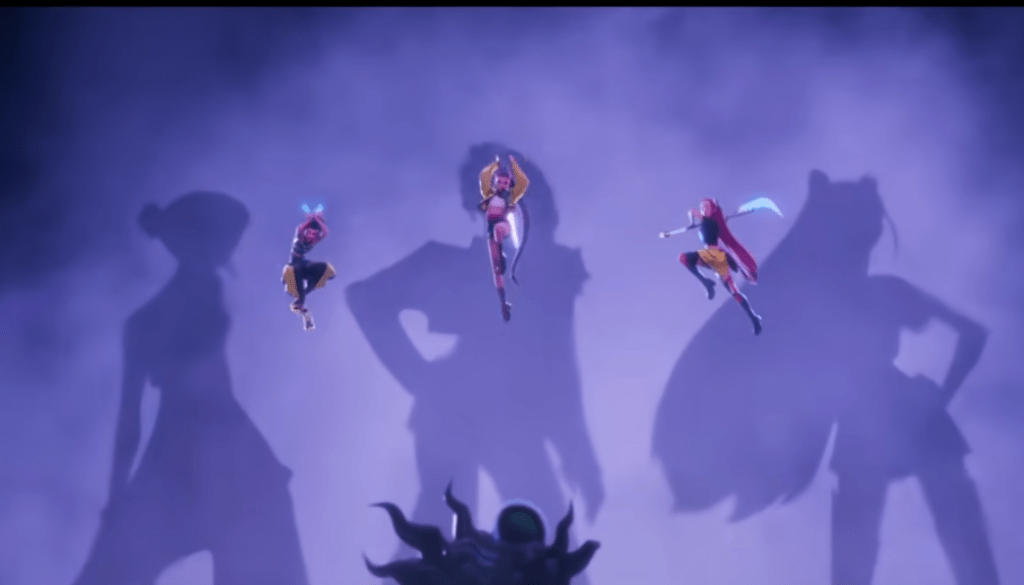
The next parallel is hymn singing, or rather just singing in this case. Angels are known for many things in the Bible, but two of them are singing hymns to represent connection between Heavens and Earth and protecting people from harm either via messaging or else. The trio in the film does a sing similar but from a different angle. They drive demons away from Earth, so it can be more like Heaven, one may argue. In other words, they spiritually connect souls of people with the Holy Spirit which protects them from evil.
In some other interpretations angels sing to glorify God and if we take into consideration that the will of God is in every person, then, the Honmoon istelf can be argue to be some sort of an energy field “made of Holy Spirit” which protects humans from evil.
The Demons and the Eternal Suffering
To continue with, The demons also are represented very closely to their depictions in Christianity. Their existence is basically an eternal suffering at the hand of Gwi-Ma who punishes them with feelings of fear and guilt.
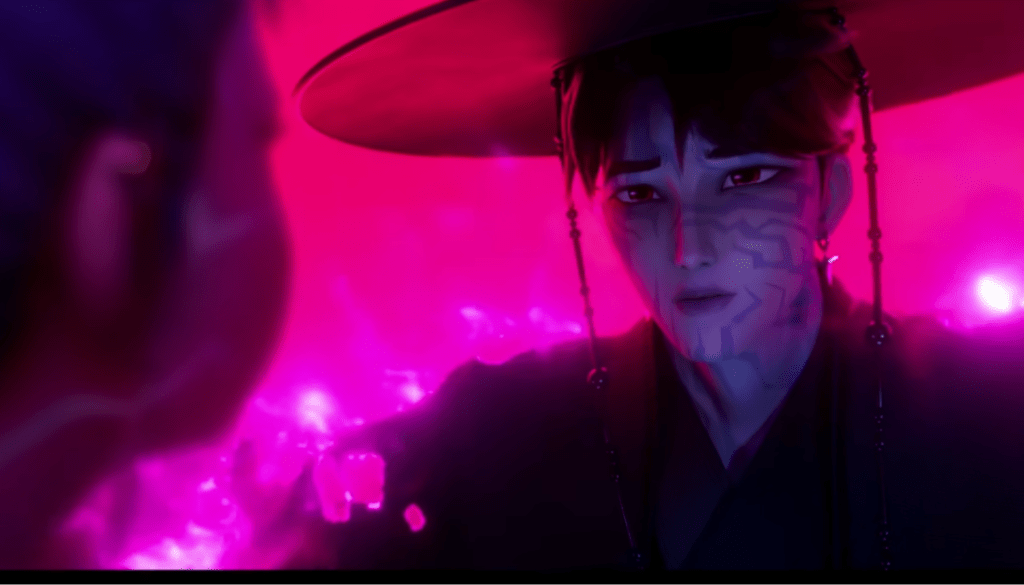
Even Jinu’s death and him giving his soul that he had previously lost back to Rumi can be considered as him being accepted by the God for he saw his repentance and desire to sacrifice himself for a good cause.
Songs and Their Themes
Like I have said before, this time I won’t talk about the lyrics but only mention the sentiment and ideas behind these two songs. To begin with, I want to compare two Huntr/x songs that they sing by the end of the film. “Takedown” represents rage and spite. It can be argued to examplify the sin of wrath in that regard. On the contrary, “What it sounds like” is honest and is sang by the girls from the heart. They act as contrasting pieces where one shows a very one-sided opinion while the other listens to everyone and accepts them as them are (in this occassion, “them” being the Huntr/x girls).
Another wonderful theme is hope and it’s represented in the song “Free” sang by Rumi and Jinu. It’s an overall good song with great message and it inspires hope to live a life devoid of fear and regret.
Finally, “Your Idol” references the Golden Calf story from the Bible when people got tired of waiting for Mouses to come with the God’s message, so they have created a calf statue made of gold to worship instead of the God. Yes, of course, it’s also a reference to the title of idol in k-pop industry, but this double implication seems to be quite intentional, especially if you listen closely to the lyrics.
Faith and Hope for the Better
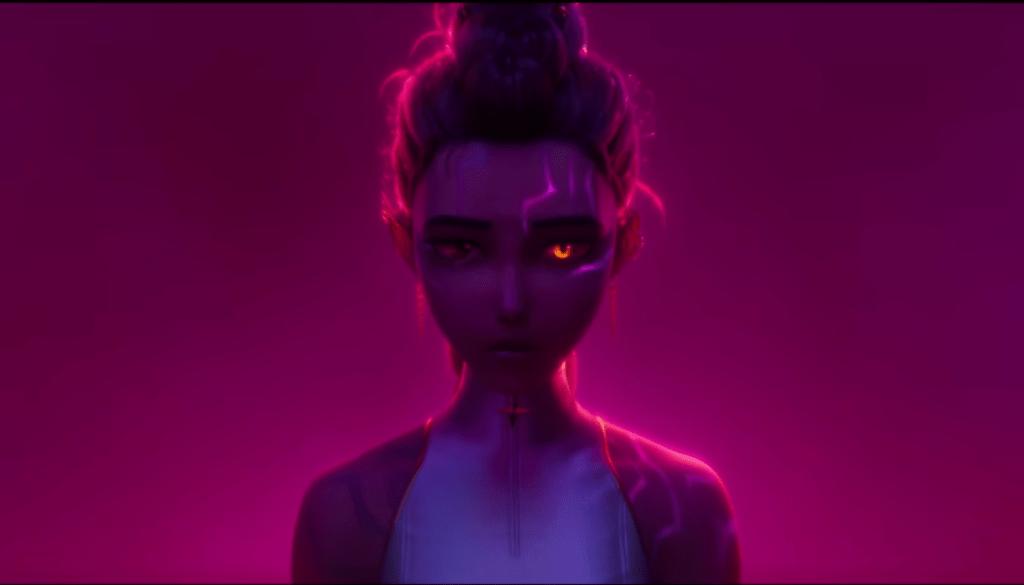
With that said, I would like to touch upon the subject of faith which is highlight in abundance in the film. It’s prominent from the start but not very noticeable until Rumi’s meeting with Jinu where suggests him to stay on Earth when the Honmoon will be sealed. She tells him “if there’s no hope for you, what hope is there for me?” To me it was the brightest signal of practically blind faith. She didn’t know if she would stay on Earth and not be dragged to the underworld, but she had faith. That’s why her return to the stadium in the end might have been shown as a twist but was very unsurprising. She truly believed that she must protect humans from demons and remained faithful till the end. That’s why her demon scars glowed in the end, she was fully accepted by the Honmoon because she had an unwavering faith in it.
The Conclusion
There are many other ideas that can be traced in the film but these are the most prominent ones and I am not that religious to be able to discern more. Some might have also slipped my mind as I was writing the post.
It’s been three weeks between my previous post and this one. I apologise for it but I got ill and couldn’t think straight. However, I am not done with K-pop Demon Hunters. Like I have stated in the beginning of the post, I also want to do an analysis of lyrics for the film. It’s very worth it for there is a lot to write about. Thank you for your time.
Finally, I wanted to say that recently I have complained about a certain scene in a Minecraft movie with Steve Garrett… Well, the is one scene like that here in the beginning, but luckily it’s only a few seconds. I… actually see a trend with series to have references like that in the beginning to later never repeat something like that for at least a long time. What is this trend? “Friends” begins with a joke about that, “Black Mirror”, “Big Band Theory”, even “Gravity Falls” to name a few. And, no, “Gravity Falls” is on the list not because of any sexual references you might have missed, I mean that the first episode explored the topic of romance which is close. But I digress. Thank you for you time. Have a great day.
 Geeky Nerd
Leave a comment