Today I want to talk about what is a relatively new hit indie game – Schedule 1 – and what makes it so popular from gameplay point of view. This game was made by one person, Tylor, who seems to know the most important part of an video game – fun. His game turned to be one of the most addictive games this year despite having very simple graphics and little to no plot. Well, that’s because what it lacks in visuals and story it makes up in full in its core gameplay and variety. I want to show in this post which elements made this game so fun to play compared to some AAA titles that came out this year.
What even is Schedule 1?
It’s a management simulator in a small town of Hyland Point. To be more precise, it’s a drug business simulator where you play as a young man or woman who learned the basics of weed growth and drug production form uncle Nelson on his ranch but after a certain predicament had to make a living for oneself in a little town of Hyland Point in our RV as our uncle is taken away by the police. You start small and then grow your empire from one or two little plants and ten packs of weed which you get at the beginning.
The premise seems very simple as Tyler, the developer of the game (yes, it was developed by one person), focused more on the core gameplay loop rather than an overarching plot. After all, it’s the gameplay that holds the game together, if it’s too boring, not to many people would be willing to play.
What is the core gameplay loop in Schedule 1?
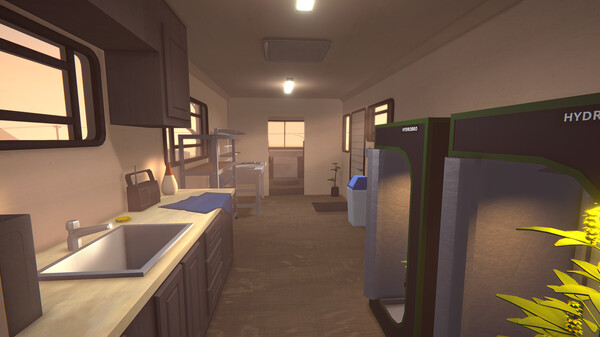
Basically, the loop goes like this:
- You plant a weed seed;
- You grow a weed seed;
- You collect the product;
- You pack the product;
- You sell the product.
And that’s just the weed. Later in game you can cook meth just like Walter White from Breaking Bad and it will be a slightly different process, bet there’s a catch.
The reason why I described every action as a separate point and didn’t mash them together was because each of these steps is a mini-game which provides some simple interactive gameplay. This gameplay is actually the main reasons why the game feels so attractive, in my opinion. Each step has an impact on the game world. You don’t simply push one button and see a small animation, you do the action yourself.
How to make a world seem real?
First of all, a colourful cast of characters. All characters in Schedule 1 are simple NPCs with a rather limited interaction list but what they lack in complex behaviour they make up with their appearance and scripted routines. Following every NPC around for a day may provide an fascinating insight into their life and affairs which sometimes can be as amusing as the main gameplay loop.
Nonetheless, I cannot say say that NPCs’ behaviour is too simplistic. Yes, their routines are scripted but the most important part of their behaviour is that player’s actions always provide a reaction from them. If you hit them, they hit you back, if you fail to steal from them, they either fight you or call the police. They don’t stay idle and allow player run rampant, they take action as well.
Additionally, like I have already mentioned above, the mini-games create an element of interactivity but unlike many other games when you may press a cequince of buttons, for instance, to successfully make an action, here you do the actual action of ripping open the dirt bag and pouring soil into the pot. By the way, shaking the soil in is indeed faster than just waiting for it to drop. The game file have a “shaking 1.3x speed booster” in them.
Making drugs is addicting
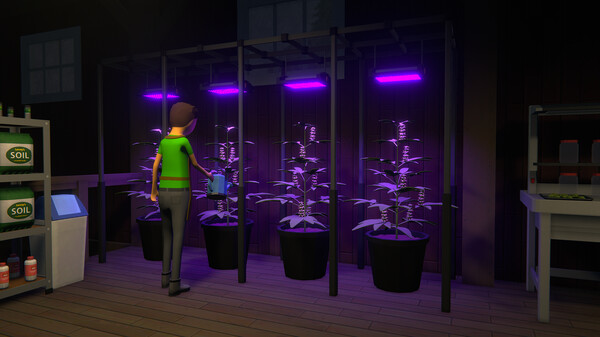
To add to the topic of interactivity with the game world I would like to talk a bit about the process of mixing drugs and what effects it’s got on the clients.
To begin with, this is the stage that allows for the most creativity and customization. The fact that it’s absolutely unrealistic also adds to the fun because it sparks curiosity. I mean, you can get a calorie-dense drug by mixing weed with a donut or make your client bold for some time with some mouth wash.
Some effects you cannot notice but those which you can definitely add a lot of fun to the process. Some of the formulas you may come up with may not even be efficient but if you want to turn the town into a bunch of green long-headed one-eyed aliens that combust from smoking, there is no one out there to stop you. (Unless you sell drugs after curfew, then the police can.)
A game is more than just graphics
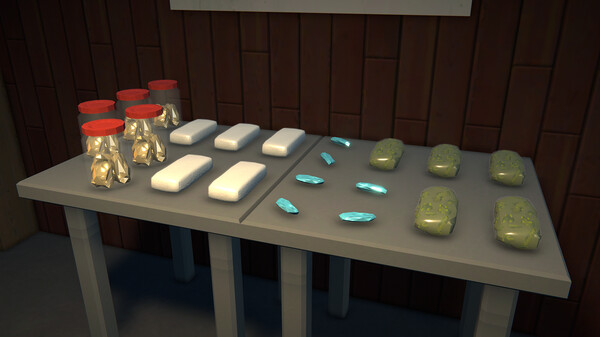
This section would mostly be a conclusion on the things that I have previously discussed. You see, Schedule 1 got out in March 2025, right next to Assassin’s Creed Shadows, and took the cake without leaving any crumbs. I’ve seen AC Shadows and in terms of gameplay it didn’t seem to bring anything fresh or fascinating to the AC core gameplay. The scenery was beautiful but it lacked character overall. To me, it’s because when a videogame goes for realism above all else in graphics it significantly diminishes the ability to be visually unique and memorable. It’s not bad then the graphics are realistic, TES Oblivion: Remastered was great, but it might also be nostalgia speaking. What I want to say is that Schedule 1 with its simplified style creates an easy to read environment which help the player “read” its world better and also makes the game visually distinct.
To continue with, many players have said that interactivity in the little actions of weed growing and drug making reminded them greatly of the potion crafting and blacksmithing in Kingdom Come: Deliverance where these processes also have little interactive “mini-games” whose purpose is to involve the player in the process. If we compare this to something like Skyrim or Don’t Starve Together, you’ll see the difference right away.
Another popular game that Schedule 1 surprisingly reminds me of is Minecraft. Of course, their crafting systems are completely different and they come from different genres but still, there is interactivity in the process of crafting that simply adds to the gameplay. It creates the illusion that your actions truly impact the world of the game by bringing in something new rather than just watch a cutscene and be done with the process.
Final Thoughts
In conclusion, I just wanted to state that this is an addictive game because it was designed to be one. It’s hard to be a solo developer, so the majority of indie games usually have to hook players by something that is easier to accomplish as one person or a small team. This something many times is the gameplay, not the story. It can be story, especially if it’s all written dialogue, but if you look at games like Balatro or Voices of the Void, which was heavily inspired by Signal Simulator, it’s possible to see that people sink in hour into the games simply because of the good gameplay loop.
After all, it’s the “easiest” thing to do for a developer, not the programming part, but creation of interactivity between game object that players would enjoy experiencing. I’ve put this in a rather vague language, but it’s still the best way to summarise it. So, if it’s hard to get, here is an example: In Genshin Impact you can collect resources like mushrooms and berries, standard RPG practice, the thing is the way Woolfhook berries are placed in a forest near Woolvendom somehow speaks to me on a personal level. I go there to collect those berries even though I don’t need any more gameplaywise. It’s just fun to walk around the forest collecting berries. That’s the key of every indie game that became successful, it was able to provide experience that the players enjoy.
If we speak about Schedule 1, then for me this experience is simply running around town doing everything that comes my way. I don’t try to rush it, I just “live” there. It’s a sort of slice-of-life game for me, a life of a criminal, something I don’t want to do in real life but the prospect of trying it out in a safe environment of a video game where no one will get hurt is ideal for such experiments.
 Geeky Nerd
Leave a comment