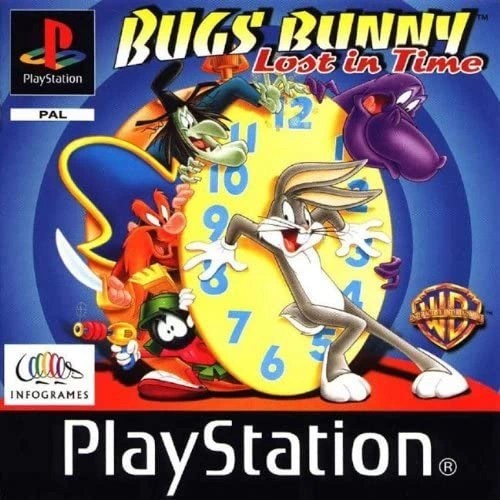
In this blog I try to write about either popular titles or some timeless classics but today it will be a bit different. I want to talk about one of my favourite games from my childhood – Bugs Bunny: Lost in Time. This is a game for PlayStation 1 (and Windows apparently) developed by Infogrames Entertainment, SA with the help of Warner Brothers in 1999. It served to me as an introduction to RPG games and made me want to actually play a game rather than just watch my cousin play.
The Plot
The plot of this game is very simple: Bugs Bunny was digging a hole to go to a beach but made a wrong turn somewhere and ended up in a barn. There he found a strange device coloured like a carrot, so he decides to investigate it. Accidentally he pushes one lever and the device gets his to Nowhere. Basically it’s a tutorial world that teaches controls and game mechanics. In Nowhere Bugs find Merlin who asks the rabbit to collect Clock symbols in order to progress through the time epochs back to his original time since the device Bugs had found was nothing less than a time machine.
That is basically all that can be said about the plot. I know, I’ve called it an RPG while in reality it’s more like a platformer with puzzles, but I was always very immersed in role-playing part of the game and didn’t consider the levels like random challenges for like like it was with Crash Bandicoot adventures. With Bugs I really felt like I was traversing time to get back home.
The game is rather linear in its structure, you cannot progress to another level until you collect enough clock symbols which makes you follow a rather predestined path, but there are still ways to make your journey diverse each time you play. There are also a few extra levels which don’t give you many resources to further your progress. They are just fun and unique mini-games compared to more classic levels of the game.
How time flies by
This game impressed me not only with easy and fun gameplay but also the variety of places and creativity of their portrayal. During the course of the game you can visit:
- Stone Age
- The Medieval Period
- Pirate Years
- 1930s
- Dimension X
Every epoch has its own gimmicks. For example, there are some special places scattered around all epochs which you can interact with after you learn how to do so from Merlin.
Fun trivia: Merlin only teaches you new tricks in the Medieval Period even though he appears throughout all eras.
Stone Age
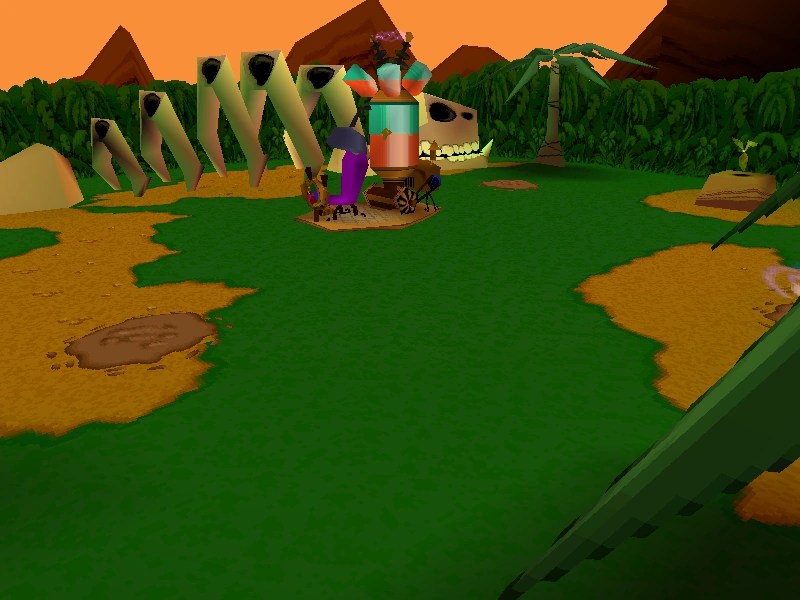
If we don’t count the tutorial world, this is the first time that you visit. It’s exactly what it looks like and more. After all, the game didn’t try to be historically accurate but rather gameplay interesting, so next to the first humans among whom you can find prehistoric Elmer Fudd, there are also many dinosaurs. Special feature of this epoch I want to mention is the pair of levels: the first level and one of the last you do there. This level has got the same roadmap in the beginning but when you start with a level in the daylight, the final level is during the night. Moreover, this last Stone age level is also quite far in the whole game roadmap, so it doesn’t just remind you about the start of your journey, but also allows you to see how well your skills have developed.
It’s bonus level is “Wabbit or Duck Season” – a hunting season argument with Daffy Duck. You have to make signs of duck hunting season and by the end of the timer if there are more duck hunting signs rather than rabbit hunting, you win. Surprisingly, Elmer Fudd here is not in his Stone Age attire but in his usual modern outfit.
The Medieval Period
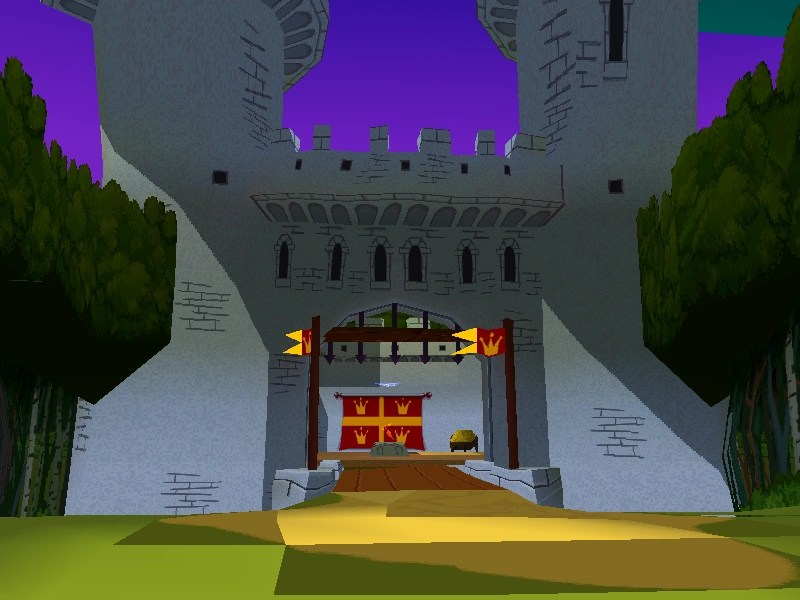
The only time period where you meet Merlin who teaches you new cool tricks. In this epoch you can find Daffy Duck, dressed as Robin Hood, who is very annoying to dodge in the first Medieval level, and appears in at least half of the levels of this epoch over all.
It’s got a peculiar bonus level – “Downhill Duck” where you fight Daffy Duck on skies. Judging by the way the two of you are dressed, this bonus level also doesn’t belong to this era.
Pirate Years
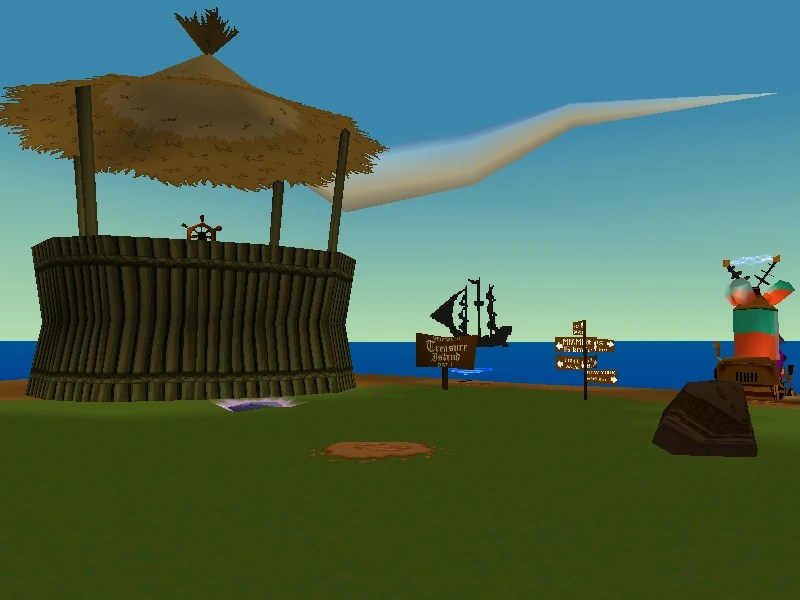
The main enemy for this era is Yosemite Sam. Here you may find one of the most tedious levels in the game where you drive the minecarts. It’s not long but if you haven’t gotten something from one section before going to the next one, there is no turning back, you have to restart a level.
Other than that, it might be the only era that uses the setting of its own time for a bonus level where you fight Sam on his ship. The level is called “When Sam Met Bunny”.
1930s
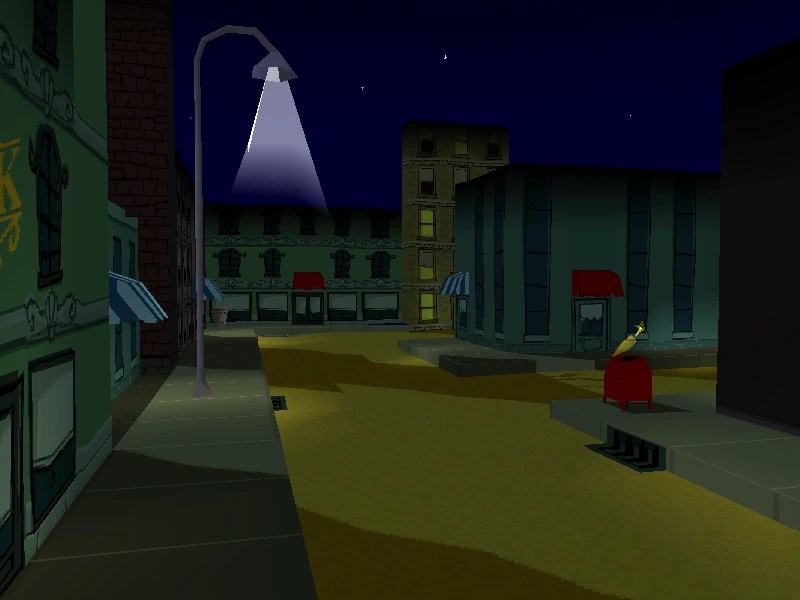
The main antagonists for this time epoch are Rocky and Mugsy. This is one of the most diverse era in terms of gameplay. It’s got linear levels, multiple stage levels and even racing. It’s also got one of the most creative levels in the game: Carrot Factory. This level is pure Looney Tunes style of imagination in terms of countless conveyer belts and platforms having flamethrowers and giant knifes. Another favourite level of mine there is the Abandoned Hotel one. It’s melancholic atmosphere created by the broken building and fascinating music still charms me.
This era has a corrida fight as a bonus level appropriately named “La Corrida”. A very easy and fun level to play. However, it’s cheerful visuals create a dissonance with the darker and more sinister tone levels of this era.
Dimension X

The final era you go to. It is supposed to represent future but there is no certainty about this. It’s final level is the most exciting level in the whole game: “Train Your Brain! (a.k.a. The Space Speedway)”. It puts all your skills to the test. Starting with Simon Says, you later would have to guess a colour combination and win a race. The main antagonist of this era is Marvin the Martian, who doesn’t like you snooping around the X dimension.
The bonus level in this era is “The Conquest for the Planet X” and it’s the only level of this era which you play fully on solid ground. This level feels like a maze and it difficult to navigate when you see it for the first time.
Looney Tunes References
There are also many references to the Looney Tunes cartoon series in the game, which is unsurprising since the whole game feels like a very long Looney Tunes episode.
Most notable references are the bonus levels scattered in all the epochs. The list of the references I have found is the following:
- “Bully for Bugs” – it’s basically the La Corrida level;
- “Duck Dodgers in the 24-1/2th Century” – it’s the setting of the Planet X level;
- “Captain Hareblower” – it’s the setting for the Pirate Years ship levels;
- “Rabbit Seasoning” – it’s the plot of the duck/rabbit hunt season special level.
- Finally, “Bugsy and Mugsy” – takes the antagonists Rocky and Mugsy for the 1930s era.
However, after some research on the topic, I’ve realised that I have left quite a few out, so here is the list of the rest of the references:
| Episode Name | What It References in Game |
| “Knight-mare Hare” | The title screen of Nowhere is based on one of its scenes. |
| “Rabbitson Crusoe” | The title screen of a Pirate level with a cave is based on the title screen from this episode. |
| “Assault and Peppered” | This one is said to be the only title screen to be from a Daffy and Speedy Cartoon. It’s the title screen for the ship battle against Sam in the game. |
| “Catty Cornered” | It’s the game’s title screen for the 1930s. |
| “Bugs and Thugs” | A scene from the credits, in the game it’s the title screen for the first level opened in 1930s. |
| “Knighty Knight Bugs” | It’s the game’s title screen for the Medieval Period. |
| “Broom-Stick Bunny” | It’s the title card of the first Medieval level. |
| “A Witch’s Tangled Hare” | It’s the title screen of the timed level of the Medieval Period. |
| “Hare-Way to the Stars” | It’s the title screen of the Dimension X and the general setting of this era. |
Of course, some may say that it’s just a desire to reuse already drawn assets and I completely agree with that, but those are not only the title screens. Some of the gameplay elements, like kicking your opponents on the rear to send the flying, ACME boxes that you collect, or Bugs’ idle animation of eating a carrot, those are all homages to the Looney Tunes’ cartoons. I love it and now I’ve got a list of cartoons to rewatch based on the game.
All in all, this post in meant to be my love letter to a dear game of my childhood which practically introduced me to the world of gaming. It holds a special place in my heart and I enjoy revisiting it from time to time. This time, though, I decided to share my memory and love with you, dear readers.
Images are taken from: https://looneytunes.fandom.com/wiki/Bugs_Bunny:_Lost_in_Time/Gallery
https://warnerbros.fandom.com/wiki/That%27s_all_Folks!
 Geeky Nerd
Leave a comment